Home
 English
 عربى
 Español
 русский
 Français
 中文简体
A facility manager replacing 120 four-foot T8 fixtures often starts with one number: 32 W per lamp. That number is incomplete. The ballast adds 2 to 15 W, and an LED tube replacing the lamp may draw 12 to 18 W at similar output. The short answer: LED lighting usually consumes less power, but the real comparison is system watts, not lamp watts.
That difference affects energy budgets, breaker sizing, emergency runtime, and retrofit payback. A specification that compares only lamp labels can overstate savings in one project and understate them in another.
The short answer: system watts decide the bill
A typical four-foot T8 fluorescent system uses 34 to 37 W: 32 W for the lamp plus 2 to 5 W for an electronic ballast. A comparable LED tube often uses 16 to 18 W. That is roughly 30% to 50% lower than T8 fluorescent, and 60% to 75% lower than older T12 magnetic-ballast systems.
Run the arithmetic. One hundred T8 fixtures at 36 W, operated 10 hours a day for 250 days, consume 9,000 kWh. Converted to 18 W LED tubes, they consume 4,500 kWh. At $0.12 per kWh, the saving is $540 per year before maintenance. Actual results depend on utility rates, operating hours, and whether the LED replacement matches delivered lumens.
How fluorescent power consumption adds up
Fluorescent lamps strike an arc through mercury vapor, which emits ultraviolet energy that phosphors convert to visible light. A ballast regulates current. Magnetic ballasts waste more power as heat; electronic ballasts reduce that loss but still consume energy. That is why a 32 W lamp rarely equals a 32 W system.
Ballast loss is not a rounding error
A magnetic ballast in a T12 fixture can add 8 to 15 W. Electronic ballasts for T8 lamps usually add 2 to 5 W. Multiply that by hundreds of fixtures, and the ballast becomes a measurable part of the load. In emergency fluorescent fixtures, the emergency ballast also manages battery charging and lamp operation during an outage.
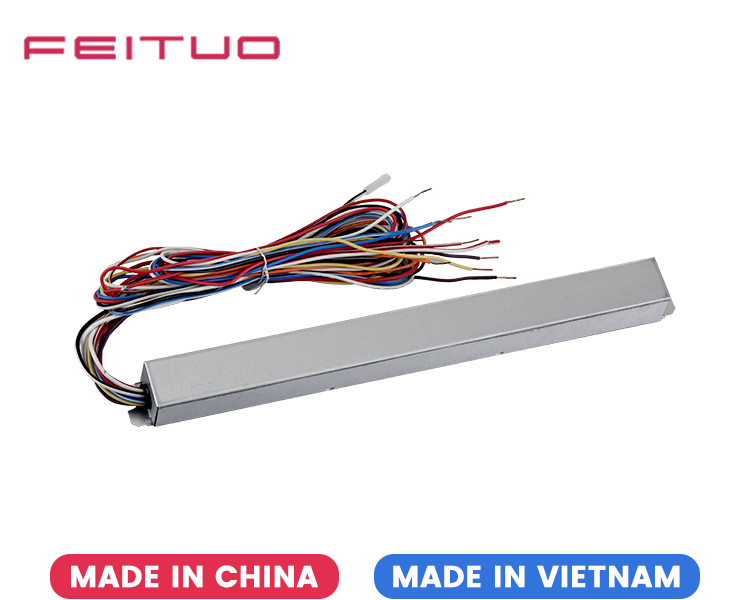 JEB Series Fluorescent Emergency Ballast for T5 and T8 LampsProvides at least 90 minutes of emergency operation for specified fluorescent lamps, with steel casing, NiCd battery, test switch, and UL compliance.View Product →
Temperature and age change the load
Fluorescent output varies with ambient temperature. Cold spaces can make starting harder; hot spaces can shorten lamp and ballast life. As lamps age, lumen output drops. Facilities may compensate by adding fixtures or accepting lower light levels, but system watts do not fall.
| Lighting type | Nominal lamp watts | Ballast or driver loss | Typical system watts | Relative power |
|---|---|---|---|---|
| 4-ft T12, magnetic ballast | 40 W | 8-15 W | 48-55 W | 100% |
| 4-ft T8, electronic ballast | 32 W | 2-5 W | 34-37 W | 70-77% |
| 4-ft T8 LED tube | 15 W | 1-2 W | 16-18 W | 33-38% |
| 4-ft T5 HO fluorescent | 54 W | 3-6 W | 57-60 W | 115-122% |
| Integrated LED panel | 30 W | 2-4 W | 32-34 W | 65-70% |
How LED power consumption behaves
LED efficacy is commonly 100 to 200 lm/W, while fluorescent systems often deliver 50 to 100 lm/W. LEDs generate light through a semiconductor, so there is no arc, mercury vapor, or electrode heating. The driver converts AC to DC, and its efficiency affects final system watts. A quality driver may be 85% to 92% efficient; poor drivers waste more heat and may have lower power factor.
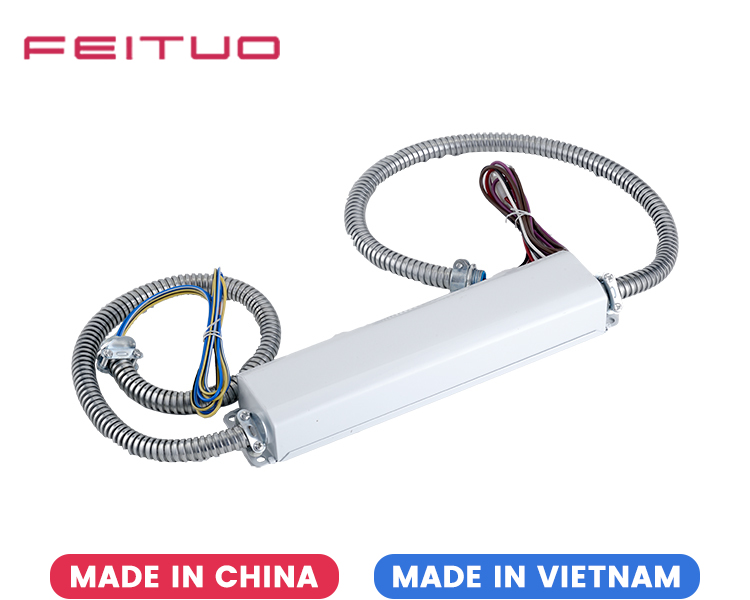 4W Constant Power Output Emergency Inverter for LED LoadsWorks with most LED loads, offers dual-voltage input, built-in NiCd battery, test switch, and at least 90 minutes emergency operation.View Product →
Power factor matters. Commercial LED drivers commonly exceed 0.9, while older magnetic fluorescent ballasts may sit near 0.5 to 0.6. Low power factor increases apparent power and current, affecting conductor and breaker sizing. LEDs also derate as junction temperature rises, so a fixture rated at 120 lm/W in an open office may deliver less in a hot ceiling. Dimming and occupancy controls can cut energy further only when the driver is compatible.
Lifecycle energy: where fluorescent loses more
Over 50,000 hours, a 36 W T8 fluorescent fixture uses 1,800 kWh; an 18 W LED replacement uses 900 kWh. The LED also avoids repeated lamp and ballast replacements. Fluorescent lamps may last 10,000 to 20,000 hours, while LED fixtures commonly claim 25,000 to 50,000 hours, depending on thermal design and driver quality.
| Item | T8 fluorescent, 36 W system | LED tube, 18 W system |
|---|---|---|
| Energy use | 1,800 kWh | 900 kWh |
| Lamp replacements | 2-5 sets | 0-1 set |
| Ballast or driver replacements | 1-2 | 0-1 |
| Mercury content | Yes, in lamps | No |
| Likely maintenance burden | Higher | Lower |
Emergency lighting: the comparison changes with the battery
In normal mode, an emergency fixture may consume little beyond battery charging. In emergency mode, the battery must drive the lamp or LED load for at least 90 minutes under codes such as NFPA 101 and UL 924. Charging, conversion, and transfer losses mean battery energy is not wall energy. Fluorescent emergency ballasts may have higher standby losses than modern LED emergency drivers, but the difference depends on the specific product and battery chemistry.
For retrofits, match the emergency driver or battery pack to the LED load, voltage, and required lumen output. An undersized inverter shortens runtime; an oversized one raises cost and standby losses. The UL E464915 certificate is an example of the compliance documentation buyers should request. For circuit differences, see how emergency ballasts differ from regular ballasts.
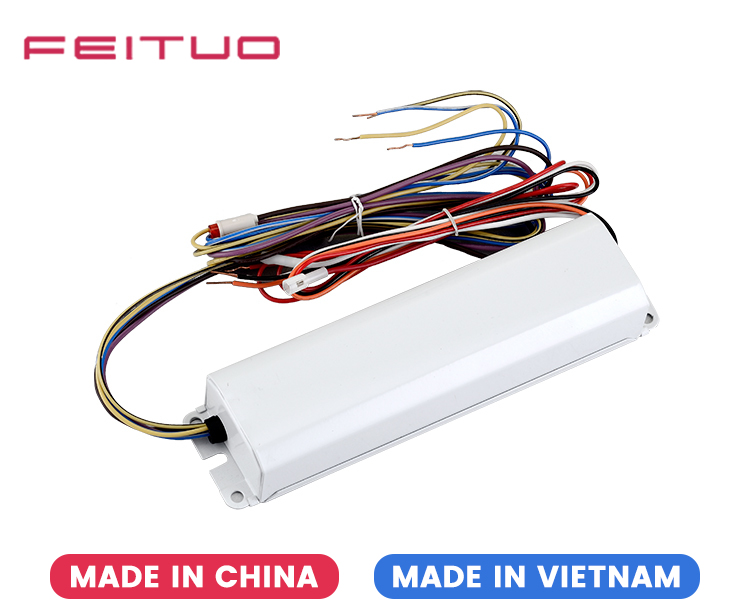 JEB Series LED Emergency Battery Pack with 700 LumensProvides 700 lumens initial output and at least 90 minutes of emergency operation using a built-in nickel-cadmium battery in a steel housing.View Product →
Battery type also matters. Nickel-cadmium, lithium-ion, and lead-acid packs have different charge profiles, cycle life, and temperature limits. A pack that performs well in an office may fail early in a warehouse or parking structure. Compare capacity, charge time, and replacement interval, not only lamp wattage.
A practical comparison path for buyers
Use a tree-style review before selecting a replacement:
- Compare system watts
- Fluorescent: lamp + ballast + controls
- LED: LED load + driver + controls
- Check power quality
- Power factor
- Total harmonic distortion
- Inrush current
- Verify emergency mode
- Battery capacity and runtime
- Charger and transfer losses
- Code-listed components
Then calculate lifecycle energy, replacement labor, and disposal. Fluorescent lamps contain mercury and require regulated disposal in many markets. LED usually wins on power consumption, but the size of the win depends on driver quality, thermal design, lumens per watt, and emergency component matching. A low-cost replacement that ignores power factor, delivered light, or battery load can erase much of the advantage.
The practical rule is simple: specify the light you need, then compare total system watts, power quality, and lifecycle cost. Fluorescent systems can still be maintained, but they carry ballast losses, mercury, and more frequent replacement. LED systems are not automatically efficient in every product, but when properly matched to the application, they typically consume less power for the same or better light.
For emergency lighting projects, extend that comparison to the battery, driver, and compliance path. The fixture with the lowest normal-mode wattage may not have the most reliable emergency runtime. Match the power profile to the space, the code requirement, and the maintenance plan.


 NINGBO FEITUO ELECTRIC APPLIANCE CO., LTD.
 0086-574-87387582
 Website: www.ifeituo.com
 info@ifeituo.com
 Mob/WeChat/WhatsApp: 0086-135-6655-7272