Home
Home English
 عربى
عربى Español
 русский
 Français
 中文简体
中文简体At 9:47 PM the power drops in a commercial building. A breaker trips, or a storm takes down the utility feed. Along the corridor, LED emergency lights switch on within seconds, drawing attention to the exit route. For the person responsible for that building, those small luminaires are not a commodity purchase. They are code-mandated safety equipment, expected to perform after years of silent standby. For an importer or distributor, choosing the right LED emergency light means balancing cost, certification, and field performance. This guide explains the parameters that actually separate a reliable fixture from one that causes a failed inspection.
What to Verify Before Comparing LED Emergency Lights
There is no single "best" LED emergency light because the right unit depends on the local code, the mounting height, and the environment of the installation. Yet four parameters define nearly every purchasing decision.
Lumen output and beam distribution
Most emergency lighting codes require at least 1 foot-candle (about 10.8 lux) at floor level along the egress path. A rated lumen figure means little if the beam is too narrow or the fixture is recessed too high. A 200-lumen twin-spot unit mounted six feet above the floor can cover a corridor more effectively than a 300-lumen unit with a narrow spot that illuminates only a small circle.
Runtime under battery power
NFPA 101 in the United States requires 90 minutes of emergency illumination after loss of normal power. Many European and Middle Eastern project specifications ask for 1 or 3 hours depending on the occupancy type. Buying a fixture with exactly 90 minutes of runtime leaves no margin as the battery ages; look for models with a tested runtime comfortably above the local minimum.
Input voltage and wiring flexibility
A fixture rated for 120–277 V covers standard North American line voltages, while a 220–240 V version suits European, Middle Eastern, and Asian grids. Dual-voltage models simplify inventory for distributors serving multiple regions. Check the terminal block as well: fixtures with screw terminals or push-in connections save time during installation and reduce the risk of loose wires in a fire-rated emergency circuit.
Self-test and monitoring features
Periodic testing of emergency lighting is mandatory in most jurisdictions. Fixtures with built-in self-test logic automatically exercise the battery and report faults, reducing manual inspection labor in large buildings. Over a ten-year service life, this feature can cut the cost of compliance significantly.
Battery Chemistry Changes the Maintenance Picture
The battery is the most failure-prone component in any emergency luminaire. Its chemistry determines how the fixture behaves in cold temperatures, how often the pack must be replaced, and how long it takes to recharge after a discharge event. The table below summarizes the options most widely used in certified fixtures.
| Battery Type | Typical Voltage | Key Advantage | Main Limitation | Typical Use |
|---|---|---|---|---|
| Nickel-cadmium (Ni-Cd) | 1.2V–9.6V | Performs well in cold environments | Lower energy density | Dual-head fixtures, exit signs |
| Nickel-metal hydride (Ni-MH) | 3.6V | Higher capacity than Ni-Cd | Faster self-discharge | Portable emergency lanterns |
| Lithium-ion (Li-ion) | 3.7V | High energy density, light weight | Requires protection circuitry | Compact modern fixtures |
| Sealed lead-acid | 4V–6V | Low cost, stable discharge | Heavy, slower recharge | High-output emergency luminaires |
Ni-Cd packs remain popular in exit signs because they tolerate the high ambient temperatures often found above ceiling tiles. Li-ion packs enable slimmer industrial designs and higher capacity in a smaller envelope. Sealed lead-acid batteries still dominate high-lumen units where weight is not a concern. The science behind LED emergency lights explains how the charging circuit keeps these batteries ready during long standby periods.
UL, cUL, and CE: Why Certification Is Not Optional
Emergency lighting is a life-safety product. No lumen output or modern design compensates for a fixture that fails to transfer to battery power when the mains supply drops. Independent certification verifies that the charging circuit, battery, and LED driver work together reliably under fault conditions.
In North America, UL 924 governs emergency lighting and exit signs. A UL-listed fixture has passed tests for wiring integrity, battery charging behavior, and photometric performance. CE marking confirms conformity with applicable European Union directives, and RoHS restricts hazardous substances in the electronics. For buyers, the absence of these marks is a red flag that the fixture may not pass a local inspection or an insurance review.
If you are sourcing from overseas, ask the manufacturer to share its certificates. Ningbo FEITUO Electric Appliance Co., Ltd., for instance, publishes its UL E464915 compliance certificate for direct review. Manufacturers that hide compliance documents usually have a reason. A certified fixture such as a UL listed dual-head LED emergency light removes one of the biggest risks in the entire procurement process.
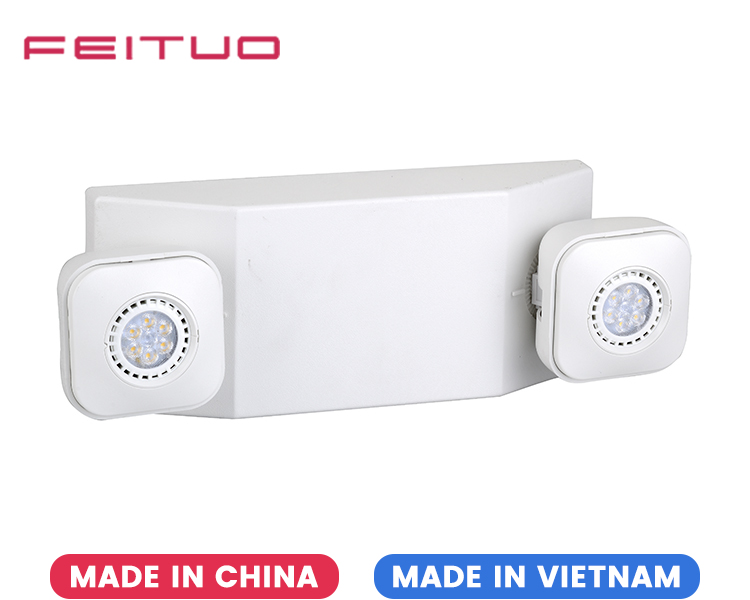 Wholesale JLEU2 UL Listed Led Emergency Light Suppliers, Factory - Ningbo FEITNingbo FEITUO Electric Appliance Co., Ltd. is China wholesale JLEU2 UL Listed Led Emergency Light suppliers and factory,UL Approved Twi...View Product →
Selecting the Right Form Factor for the Space
Different areas of a building require different emergency luminaires. Matching the form factor to the physical environment is the difference between a fixture that disappears into the architecture and one that creates problems during installation or maintenance.
Twin-spot and dual-head fixtures
Twin-spot emergency lights dominate corridors, stairwells, and open-plan offices. Their adjustable heads let an installer aim light exactly where the egress path requires it. Wire guards and polycarbonate diffusers protect against impact in warehouses and loading bays.
Waterproof bulkhead fixtures
Parking garages, canopies, and wash-down areas demand an IP65 rating. A waterproof bulkhead fixture with an ABS housing and clear polycarbonate diffuser withstands rain, humidity, and dust without degrading the LED module. The LE511AD clear polycarbonate bulkhead emergency light is a natural fit for these outdoor or semi-outdoor locations.
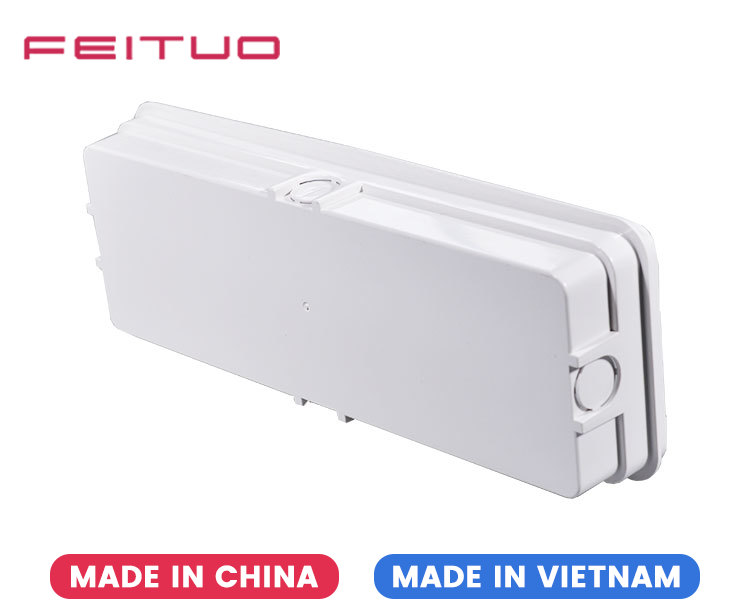 Wholesale LE511AD Clear Polycarbonate Diffuser & ABS Housing Emergency Light SupNingbo FEITUO Electric Appliance Co., Ltd. is China wholesale LE511AD Clear Polycarbonate Diffuser & ABS Housing Emergency Light supplier...View Product →
Exit signs and combination units
Exit signage is mandated above doors and along escape routes. A combo unit merges an LED exit sign with integrated emergency light heads, reducing the number of fixtures and the cost of installation. For facilities that need bilingual or symbol-based signage, manufacturers offer customizable lettering colors and pictograms. An LED emergency exit sign with green letters with integrated heads can cover both illumination and signage in a single footprint.
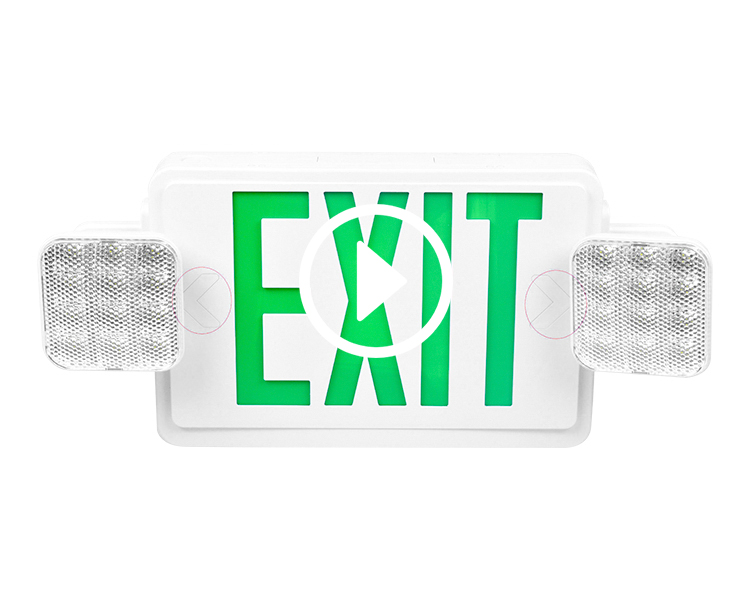 Wholesale JLEC2GW-LED Combo Emergency Exit Sign with Green Letters Suppliers, FaNingbo FEITUO Electric Appliance Co., Ltd. is China wholesale JLEC2GW-LED Combo Emergency Exit Sign with Green Letters suppliers and fact...View Product →
Remote heads and downlights
Remote lamp heads allow a central battery unit to feed several light points, which is useful in large open spaces or where the battery cannot be positioned near the lamp. Recessed emergency downlights preserve ceiling aesthetics in lobbies and offices while still meeting code.
What OEM Buyers and Distributors Should Ask
Distributors and project buyers rarely need a generic catalog fixture. They need a unit that matches a specification, carries the right certification, and arrives on schedule. That makes the manufacturer's production depth as important as the product itself.
Ask whether the factory controls its own injection molding, metal stamping, and SMT assembly. A manufacturer with in-house tooling can adapt housing materials, battery capacity, mounting brackets, or even the diffuser finish without long supply-chain delays. Ask for the warranty terms as well: a five-year warranty on electrical components and a three-year warranty on batteries is a reasonable benchmark for a serious supplier.
Finally, request samples and test them under real conditions. Verify the charging curve, measure the actual runtime with a fresh battery, and confirm that the fixture switches to battery power reliably when the mains is disconnected. A certified, production-tested product will pass these checks consistently.
Choosing the right LED emergency light is ultimately a risk management exercise. The fixture must satisfy an inspector on day one and still perform years later when the power fails. Focus on lumen output, battery chemistry, certification, and the physical form factor. If the manufacturer can prove its claims with certificates and samples, the rest of the procurement decision becomes straightforward.


 NINGBO FEITUO ELECTRIC APPLIANCE CO., LTD.
 0086-574-87387582
 Website: www.ifeituo.com
 info@ifeituo.com
 Mob/WeChat/WhatsApp: 0086-135-6655-7272