Home
Home English
 عربى
عربى Español
 русский
 Français
 中文简体
中文简体When the power drops in a multi-story office building, the fixtures that matter most are not the ones that shut off. They are the ones that switch on automatically and guide people toward the exits. An emergency LED light has one job: to operate when the mains fail and to keep working for a defined period, typically 90 minutes, without any manual help. The practical difference between a dependable fixture and a marginal one shows up in battery chemistry, charging circuit, housing material, and certification, not in the brightness figures on the box.
What an Emergency LED Light Actually Does
An emergency LED light is a self-contained luminaire that includes a battery, a charger, and a control circuit that detects loss of mains power. When the supply voltage drops below a set threshold, the fixture transfers to battery operation and lights its surrounding area. When the mains returns, it recharges automatically.
Two operating modes matter in practice. A maintained unit stays lit at all times and doubles as ordinary lighting. A non-maintained unit stays dark during normal operation and only switches on when the power fails. Most code requirements are met with non-maintained units in spaces that already have general lighting, while maintained units suit corridors, lobbies, and public areas where darkness is not acceptable even under normal conditions.
Emergency lights also have to be predictable. The battery must hold capacity after months of float charging, the transfer circuit must switch without chattering, and the LEDs must still produce useful output at the end of the discharge period, not just for the first few minutes.
Why LED Has Become the Standard
Incandescent twin-spot heads and fluorescent bulkheads remain in older buildings, but LED is now the default source for new emergency fixtures. The reason is efficiency, not style. An LED head delivers equal or better light output while drawing a fraction of the power of an incandescent lamp. That reduction directly shrinks the battery size needed for a 90-minute runtime, or allows the same battery to support a brighter fixture.
LED also gives designers better control over the beam. A wall-mounted unit with two adjustable spot heads can aim light precisely where the exit path turns, while a recessed emergency downlight can sit flush in a ceiling and blend with the normal lighting until the outage occurs.
Key Specifications to Compare Before Buying
Lumen output grabs attention first, but three values matter more: battery chemistry, operating mode, and rated duration. Together, they decide whether the fixture will pass inspection and remain reliable five years later.
Battery Chemistry
Commercial emergency lights rely mainly on three battery families: nickel-cadmium (Ni-Cd), sealed lead-acid, and lithium-ion. Each handles continuous float charging and repeated discharge cycles differently.
| Battery type | Typical ratings | Float charge behavior | Common role |
|---|---|---|---|
| Ni-Cd | 1.2V, 3.6V, 4.8V | Very tolerant, long service life | Twin-spot units, bulkheads, exit signs |
| Sealed lead-acid | 4V, 6V | Good capacity, shorter cycle life | High-output fixtures, remote-head systems |
| Li-ion | 3.7V | High energy density, long calendar life | Slim fixtures, portable units, compact exit signs |
Ni-Cd remains common in code-mandated fixtures because the chemistry tolerates the slight overcharge that occurs when a unit sits connected for months. Li-ion offers more energy in a smaller envelope, which enables thinner enclosures. Sealed lead-acid is still economical for high-lumen fixtures where a larger battery compartment is acceptable.
Rated Duration and Output
Most commercial codes require 90 minutes of emergency operation, and some project specifications ask for 120 minutes. Confirm the rated duration by testing a sample rather than trusting the label. A fixture that falls below the code minimum at minute 70 has failed its job even if the LED still glows.
Output is only part of the story. What matters is useful illumination on the surfaces people actually walk on, which means the spread and aiming of the heads influence performance more than raw lumens.
Certification Separates Real Fixtures from Decorative Ones
An emergency LED light that fails a code inspection is a bad deal at any price. The decisive question is what standard the fixture was tested against. In North America, UL 924 covers emergency lighting and exit signs. In Europe, the EN 60598 series applies, with CE marking and RoHS material restrictions. Buyers who skip this step often discover that a bargain fixture cannot be installed in a building that requires an inspector's sign-off.
A manufacturer with genuine approval will publish the evidence. FEITUO's UL E464915 compliance certificate covers the emergency lighting range and is available for direct review. That kind of documentation, verified against the issuing body, is worth more than a paragraph of marketing claims when you compare factories. For projects that follow the National Electrical Code or NFPA 101, choosing a listed fixture is not optional; it affects occupancy, insurance, and liability.
Compliance also extends to materials. A UL 94V-0 flammability rating on the housing and diffuser means the plastic resists ignition and stops burning when the flame source is removed. That detail matters in stairwells, mechanical rooms, and recessed ceiling installations where a fixture sits near structural elements.
Matching the Fixture to the Building
Different spaces need different fixture formats. For open floor areas, corridors, and stairwells, a wall-mounted unit with two adjustable heads covers a wide zone with a flexible beam. A UL 94V-0 flame-rated twin-head emergency LED light is a practical starting point because the flame-rated housing suits ceiling voids and storage areas where code requirements are strictest.
In lobbies, hotel corridors, and office fit-outs where exposed boxes look wrong, a recessed emergency LED downlight preserves the architectural ceiling while still delivering code-level illumination on the floor. The fixture behaves like a normal downlight during regular operation and switches to battery power the moment the mains disappear.
For exit paths that need combined signage and illumination, a green-letter LED emergency exit sign combo integrates the sign and one or more light heads in a single housing. This reduces installation labor, wiring, and the number of battery units a facility manager must test and replace.
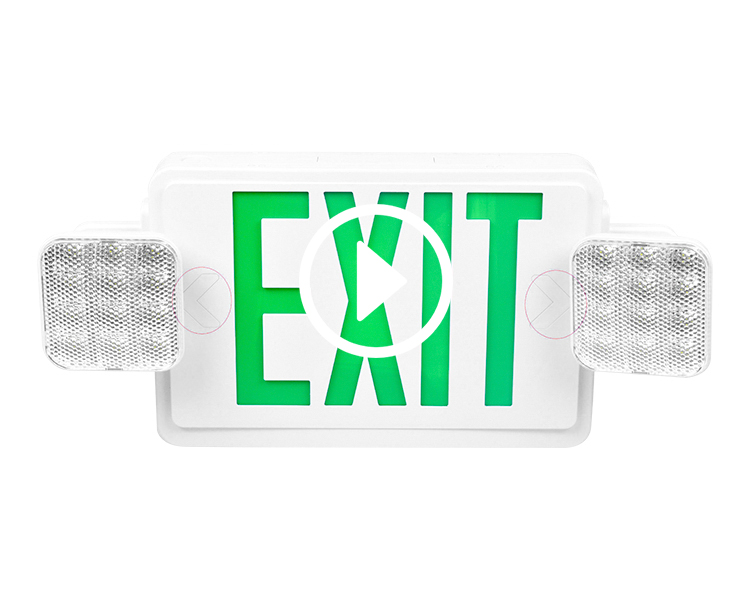 Wholesale JLEC2GW-LED Combo Emergency Exit Sign with Green Letters Suppliers, FaNingbo FEITUO Electric Appliance Co., Ltd. is China wholesale JLEC2GW-LED Combo Emergency Exit Sign with Green Letters suppliers and fact...View Product →
The common thread is that fixture selection should follow the building layout and the local code, not a catalog page. A fixture that is easy to maintain and test over the life of the building will outperform a slightly brighter unit that is awkward to service.
What to Inspect in the Product and the Supplier
Spec sheets from different factories can look nearly identical while the physical fixtures differ in ways that show up only after installation. When evaluating a supplier, or checking a batch on arrival, focus on these details.
Housing, Diffuser, and Flame Rating
ABS and polycarbonate are the two dominant housing materials. Polycarbonate handles heat and impact better, and a clear polycarbonate diffuser transmits more light than a frosted one. If the fixture sits in a ceiling void or near fire-rated elements, confirm that the plastic carries a UL 94V-0 rating rather than assuming it does.
Battery Connections
Loose or corroded battery terminals are among the most frequent field failures in emergency lights. Look for spot-welded battery tags or soldered connections with strain relief. Friction-fit clips that can dislodge during shipping create intermittent faults that are hard to find during routine testing.
Charging and Transfer Circuit
An emergency LED light spends most of its life in the charging state. The charger must limit current to protect the battery, and the transfer circuit must switch quickly when the mains fail. That is why the dual independent circuit design of twin-spot emergency lights matters: separating the charging branch from the emergency branch keeps each function stable and makes the fixture easier to diagnose when something goes wrong.
Make Reliability the First Requirement
An emergency LED light is a safety device before it is a lighting product. Start with certification and verified battery performance, then look at housing and circuit quality, and finally consider features such as adjustable heads, remote-head capability, and dual brightness modes. The fixture that serves you best is the one that switches on every time, holds its output for the full duration, and can be installed and serviced without hidden costs.


 NINGBO FEITUO ELECTRIC APPLIANCE CO., LTD.
 0086-574-87387582
 Website: www.ifeituo.com
 info@ifeituo.com
 Mob/WeChat/WhatsApp: 0086-135-6655-7272