Home
Home English
 عربى
عربى Español
 русский
 Français
 中文简体
中文简体Why LED Emergency Lights Are Now the Default for Commercial Buildings
A facility manager in Ohio had just completed a retrofit of emergency fixtures before a scheduled fire marshal inspection. When the inspector cut power to the building, three of the new units took almost four seconds to transfer to battery, and the light output measured well below what the corridor required. The fixtures were labeled as LED emergency lights, but the transfer time, lumen output, and battery condition had never been checked against the code.
That scenario is worth keeping in mind whenever you buy emergency LED lighting for a commercial building. The move to LED is no longer a technology decision; it is a specification decision. An LED emergency light succeeds or fails based on its driver, battery, housing, and certification, not just the LED board it carries.
LED fixtures deliver full brightness almost instantly, which is exactly what emergency egress lighting needs. They draw far less power than incandescent or fluorescent units, so the backup battery is not taxed as hard during a 90-minute discharge. They also run cooler and last considerably longer, which means the light source itself will not be the component that fails first. In practical terms, LED emergency lighting makes it easier for a building to meet the foot-candle levels required along egress paths at a lower ongoing energy and maintenance cost.
For a B2B buyer, the takeaway is direct: LED is the right base technology, but the purchase decision depends on the specific model's compliance, battery, and fit for the space.
Check Certifications Before You Compare Prices
A simple rule avoids most of the risk in emergency lighting procurement: check the certification before you compare prices. In the United States, UL 924 is the standard that governs emergency lighting equipment. It sets the requirements for automatic transfer to battery power, the 90-minute duration of emergency operation, and the photometric output the fixture must maintain. Canada uses the cUL listing for equivalent protection, while the European market typically requires CE marking and RoHS compliance for restricted substances.
Flame resistance is another specification that buyers often overlook. A UL 94V-0 rating on the housing material means the plastic is self-extinguishing, which is important for insurance reviews and local code approval. When a fixture uses ABS or polycarbonate housing, the V-0 rating should appear in the technical data sheet.
| Certification | Primary market | What it verifies |
|---|---|---|
| UL 924 | United States | Emergency transfer, 90-minute runtime, and output performance |
| cUL | Canada | Equivalent safety compliance for Canadian installations |
| CE | European Economic Area | Compliance with applicable low-voltage and electromagnetic compatibility directives |
| RoHS | European Union and other regions | Restricted hazardous substances in materials and components |
| UL 94V-0 | International | Flame-retardant performance of plastic housings |
When reviewing documentation, ask for the certificate that lists the specific model number. A generic company-level compliance claim is not enough for most authorities having jurisdiction. A manufacturer that can produce model-specific UL and CE documents, including the test report, will make your approval process considerably shorter.
Battery Chemistry Decides Long-Term Reliability
The LED board gets most of the attention, but the battery decides whether the fixture still works in its third year. Most building codes require at least 90 minutes of emergency illumination, so the battery must hold its capacity, tolerate the building's temperature range, and survive repeated charge and discharge cycles.
Four chemistries dominate the market. Nickel-cadmium (NiCd) remains common in emergency fixtures because it handles cold temperatures and delivers a steady discharge profile. Nickel-metal hydride (NiMH) offers higher capacity without cadmium. Lithium-ion packs are lighter and more energy-dense, which suits slim fixture designs, but they need protection and charge-management circuitry. Sealed lead-acid batteries are cost-effective and deliver high current, but they are heavy and have a shorter cycle life.
| Chemistry | Typical ratings | Strengths | Main considerations |
|---|---|---|---|
| NiCd | 1.2V to 9.6V; 600 to 1000 mAh | Cold tolerance, stable discharge | Cadmium restrictions in some markets |
| NiMH | 3.6V to 7.2V; 600 to 1800 mAh | Higher capacity, no cadmium | Slightly higher self-discharge rate |
| Li-ion | 3.7V; 1000 to 1200 mAh | Light weight, high energy density | Requires protection and charge-management circuits |
| Sealed lead-acid | 4V to 6V; 2.5 to 4 Ah | Low cost, high current output | Heavy; shorter cycle life |
For buyers who assemble their own fixtures or need to replace battery packs, the voltage and capacity should match the original equipment specification. If your project requires a specific chemistry or capacity, you can review the rechargeable emergency battery options available directly from a manufacturer that controls battery sourcing.
Match the Fixture Type to the Installation
Certification and battery chemistry form the technical foundation, but the physical fixture is what you mount, wire, and inspect. Choose the format based on the space, the mounting surface, and the environmental rating.
Maintained vs. Non-Maintained Operation
Maintained units double as normal lighting fixtures and stay on continuously, drawing from the building supply. Non-maintained units remain off until the mains fail, then switch to battery power. Some fixtures offer dual-brightness modes that use the LEDs at reduced output as a nightlight and jump to full output during an emergency. Match the operating mode to the building's lighting schedule and code requirements.
For corridors, stairwells, and open work areas, wall-mounted dual-head fixtures are the most common solution because the lamp heads can be aimed to cover the path of egress. A certified unit such as the UL-listed twin-head LED emergency light combines adjustable heads, a UL 924 listing, and a flame-rated housing in one package.
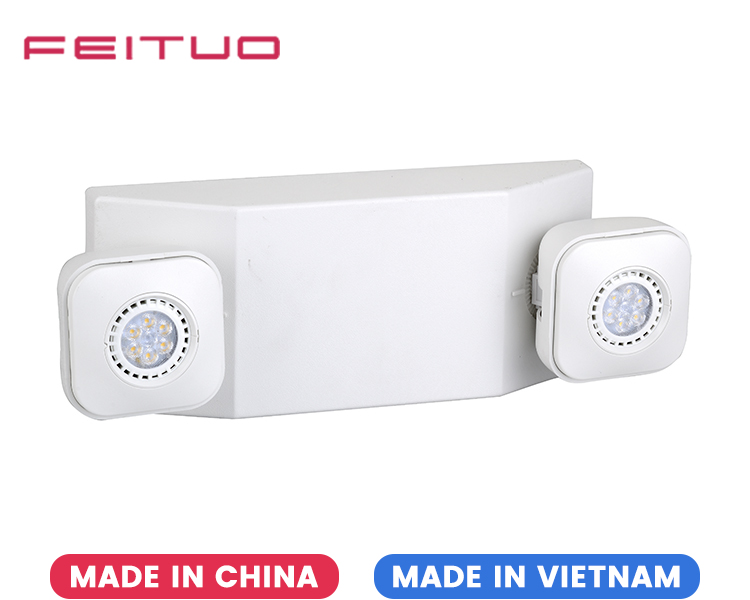 Wholesale JLEU2 UL Listed Led Emergency Light Suppliers, Factory - Ningbo FEITNingbo FEITUO Electric Appliance Co., Ltd. is China wholesale JLEU2 UL Listed Led Emergency Light suppliers and factory,UL Approved Twi...View Product →
Where water or humidity is involved, sealed bulkhead fixtures with an IP65 rating are the safer choice. IP65 means the unit is dust-tight and protected against water jets, which makes it suitable for canopies, parking garages, exterior walkways, and washdown areas. The IP65-rated 50-LED waterproof emergency light is a compact bulkhead unit designed for exactly these positions.
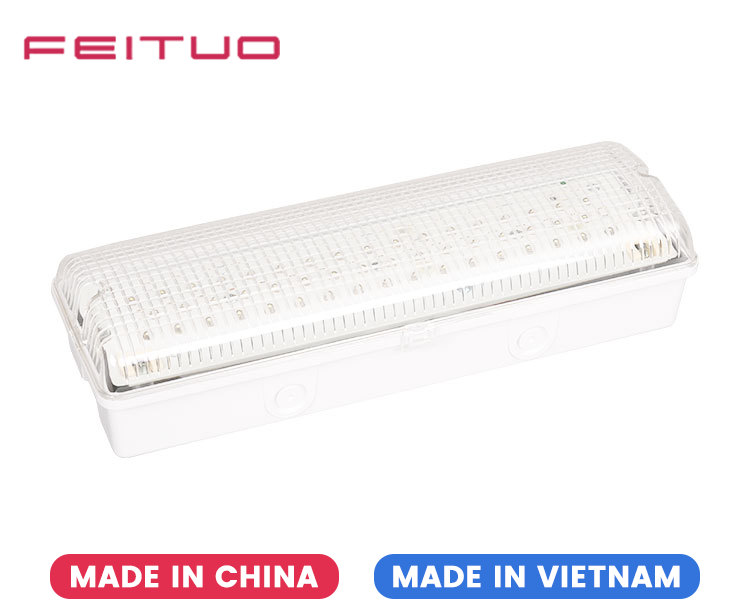 Wholesale LE502L IP65 50LED Waterproof Emergency Light Suppliers, Factory - NingNingbo FEITUO Electric Appliance Co., Ltd. is China wholesale LE502L IP65 50LED Waterproof Emergency Light suppliers and factory,50Led Wa...View Product →
- Emergency downlights fit recessed ceiling positions in lobbies, offices, and restrooms where a surface-mounted box would look out of place.
- Exit signs and combination units mark the egress route and add directed illumination without a separate fixture footprint. You can review the dedicated exit sign category for single-face, double-face, and combo formats.
- Remote-mounted lamp heads connect to a central battery and driver enclosure, letting you spread light across a larger floor plan while keeping the power equipment in one serviceable location.
Confirm the mounting method, the direction of the lamp heads, and whether the fixture is rated for surface, recessed, or pendant installation before you commit to a layout.
For Lighting OEMs: Add Emergency Capability With Drivers and Battery Packs
If your company manufactures LED luminaires, you do not have to redesign the whole fixture to add emergency capability. Emergency drivers, inverters, and battery packs integrate with the existing LED driver circuit and switch the fixture to battery power when the AC supply drops.
Three specifications matter most when selecting an emergency power pack for a luminaire program. Constant power output keeps the light output stable regardless of input voltage. Dual-voltage operation, typically 120V to 277V, simplifies inventory because one unit works across common North American supply voltages. And the choice between an internal or external battery pack affects the fixture envelope and service access.
For OEM integration into North American fixtures, the power pack should carry its own listing. A UL and cUL listed LED emergency battery pack gives you documented transfer behavior and a recognized safety mark, which shortens the time needed to certify the finished luminaire.
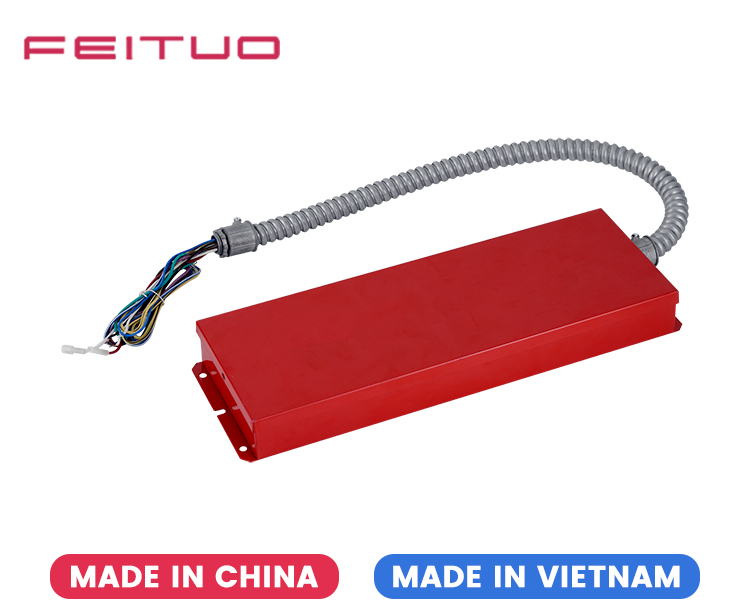 Wholesale UL and CULus Listed LED Emergency Battery Pack Suppliers, Factory - NNingbo FEITUO Electric Appliance Co., Ltd. is China wholesale UL and CULus Listed LED Emergency Battery Pack suppliers and factory, ...View Product →
Battery capacity and chemistry should be matched to the fixture's wattage and the required runtime. That is why manufacturers who control both the power electronics and the battery supply, rather than buying generic packs, tend to deliver more consistent performance.
How to Qualify an Emergency Lighting Manufacturer
The lowest quoted price on emergency lighting is rarely the lowest total cost. If a fixture lacks model-specific certification, uses a battery that degrades quickly, or carries an IP rating that has not been verified, the problems show up during inspections or, worse, during an actual power loss.
When you qualify a manufacturer, look for evidence of control over the production process. FEITUO operates injection molding, metal stamping, transformer production, automatic winding, SMT placement, and PCB assembly lines under one roof, which means the housing, power electronics, and circuit boards are all made in the same facility. The company states a research and development team with more than 20 years of emergency lighting experience, maintains ISO9001 quality management, and supports UL, CE, and RoHS certification for export markets.
Customization, Prototyping, and Regional Compliance
Most emergency lighting projects involve some degree of tailoring. Buyers often need custom shapes, lettering, voltages, or bilingual exit legends such as SALIDA for Spanish-speaking markets. A capable OEM partner will adjust shape, size, and function, build a prototype for approval, and then move to mass production once the design is confirmed. They should also help align the finished product with local and international safety standards.
Warranty terms matter just as much as the initial specification. FEITUO offers up to five years of warranty on electrical components and housings and three years on batteries, and commits to responding to inquiries within 24 hours. For a B2B buyer, those terms are a measurable layer of protection over the purchase.
Use this checklist when you compare suppliers:
- Confirm the governing standard in your market (UL 924, CE, or local code) and ask for the certificate with the exact model number.
- Verify battery chemistry and the stated runtime at the building's minimum and maximum operating temperatures.
- Check IP and flame-rating data for outdoor, wet, or high-risk locations.
- Choose the fixture type based on mounting, coverage area, and maintained or non-maintained operation.
- For OEM programs, put prototype lead times, packaging, and warranty terms in writing before placing a production order.
Start with the code, then work backward to the fixture. When the power fails and the building fills with people, the emergency LED light has one job: come on quickly and stay bright long enough. A certified, correctly specified unit from a manufacturer with the production depth and warranty to back it up is the difference between a routine inspection and a call you do not want to receive.


 NINGBO FEITUO ELECTRIC APPLIANCE CO., LTD.
 0086-574-87387582
 Website: www.ifeituo.com
 info@ifeituo.com
 Mob/WeChat/WhatsApp: 0086-135-6655-7272