Home
 English
 عربى
 Español
 русский
 Français
 中文简体
A 240-foot corridor, one exit sign at the far end, and a failed inspection: that is how NFPA 101 exit sign requirements usually surface for facility teams. The code is not vague about the basics. A compliant sign has 6-inch block letters, a 3/4-inch stroke, continuous illumination, and a rated viewing distance that keeps every point in the exit access within 100 feet of a visible sign. Power loss does not suspend the rule; the sign must stay lit for at least 90 minutes.
NFPA 101 does not treat exit signs as decoration. It treats them as measurable life-safety devices. That is good news for buyers and inspectors, because most deficiencies can be checked with a tape measure, a light meter, and a test button.
What NFPA 101 Requires: The Short Version
NFPA 101, Life Safety Code, addresses exit signs primarily in Chapter 7, Marking of Means of Egress. The core requirements sit in 7.10.1 and are repeated or modified by occupancy chapters. Four checks catch most field deficiencies: size, illumination, placement, and maintenance.
| Checkpoint | NFPA 101 expectation | Field verification |
|---|---|---|
| Letter height | 6 in. (150 mm) minimum | Measure the letter, not the sign housing. |
| Stroke width | 3/4 in. (19 mm) minimum | Thin fonts and decorative faces fail. |
| Letter spacing | 3/8 in. (9.5 mm) minimum | Check the gap between letters. |
| Illumination | Continuous; externally illuminated face at 5 fc (54 lux) minimum | Meter the face and confirm no dark spots. |
| Power duration | 90 minutes on emergency power | Test battery-backed and generator-backed signs. |
| Spacing and viewing | No point in the exit access more than 100 ft (30 m) from the nearest visible sign | Walk the corridor with a tape measure. |
| Low-location marking | 4 in. symbol where the occupancy requires it, typically 6 to 18 in. above the floor | Check the occupancy chapter and local amendments. |
| Testing | Monthly 30-second functional test; annual 90-minute test | Keep written records with corrective actions. |
Letter Size, Contrast, and the 100-Foot Rule
The 6-inch letter is not a suggestion. NFPA 101 requires block letters with a stroke width of at least 3/4 inch and spacing of at least 3/8 inch. NFPA 101 recognizes red and green, but some jurisdictions limit exit signs to red, so confirm the local requirement before ordering. The sign must contrast with its background and remain legible when illuminated. A common field failure is a 5-inch letter on a decorative plate; another is a sign whose rated viewing distance is shorter than the corridor it serves.
NFPA 101 also caps the distance between signs: no point in the exit access may be more than 100 feet from the nearest visible exit sign. That is a maximum, not a target. A sign rated by UL 924 for a shorter viewing distance must be placed closer. In a long corridor, that often means repeating signs at 100-foot intervals or at every change of direction.
Illumination and the 90-Minute Power Test
Exit signs must be illuminated at all times. Internally illuminated signs must be listed to UL 924. Externally illuminated signs must receive at least 5 footcandles on the face from a reliable source. The emergency power supply, whether a battery inside the sign, a central inverter, or a generator, must keep the sign lit for at least 90 minutes during a power failure. The same 90-minute rule applies to emergency lighting that illuminates the path of egress.
This is where low-cost imports and unlisted retrofit kits create risk. A sign can have the right letter size and still fail because the battery is undersized, the LED driver is not listed for emergency operation, or the sign is connected to a normal lighting circuit only. Ask for the UL 924 listing and the emergency duration in writing. If the sign is installed in a wet location, such as a covered walkway or parking structure, the enclosure rating matters as much as the letter size.
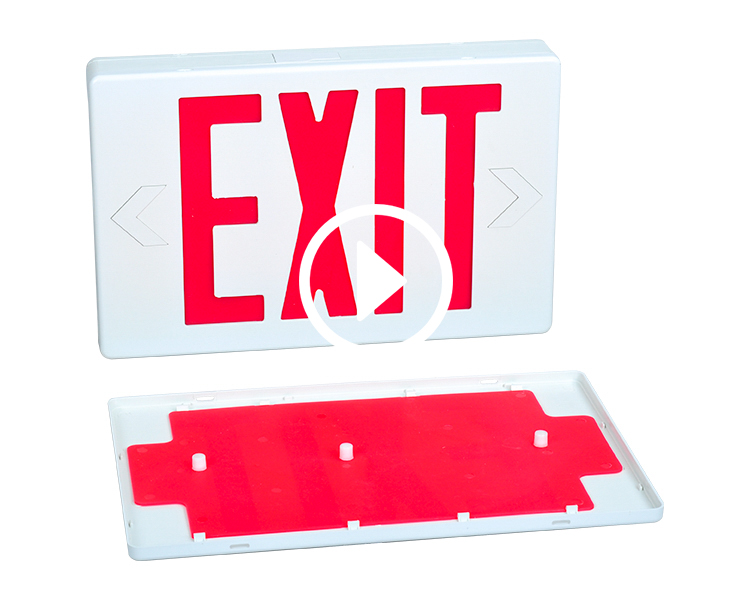 JEE2RWE UL-Listed Red LED Exit SignA 6-inch red LED exit sign with UL 924 listing, 90-minute backup, and damp-location rating for indoor commercial egress checks.View Product →
For indoor commercial projects, a UL-approved red exit sign with a steel or plastic housing is the baseline choice. For damp or wet locations, specify a sealed enclosure and confirm the IP rating against the actual mounting environment.
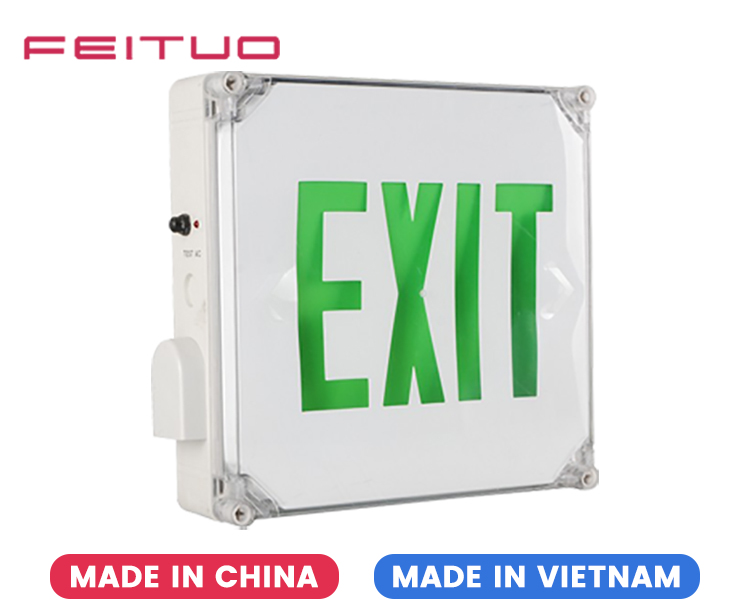 JEEWPG Wet-Location Green LED Exit SignA green-letter exit sign rated for wet locations, with 90-minute battery backup and dual-voltage options for outdoor commercial egress.View Product →
Placement, Directional Arrows, and Obstructions
NFPA 101 requires an exit sign at every exit. Where the exit is not immediately visible, the sign must include a directional indicator, usually a chevron. Signs must be unobstructed and visible from the approach. A sign mounted above a door is not compliant if a soffit, duct, or banner blocks it from the corridor. Directional signs belong at intersections, at the top of stairs, and wherever the path of egress changes direction.
Low-location exit path marking is a separate requirement. Where the occupancy chapter triggers it, a 4-inch luminous symbol must be placed near the floor, typically 6 to 18 inches above the finished floor, so occupants can follow the path in smoke. It supplements the overhead exit sign; it does not replace it. Assembly occupancies, hotels, and large mercantile spaces are common triggers, but the exact scope depends on the code edition and local amendments.
Mounting height also affects visibility. A sign placed too high in a tall atrium may fall outside the viewer's cone of vision; a sign placed too low may be blocked by shelving or equipment. The practical test is a walk-through at occupant eye level, not a review of the floor plan alone.
Testing and Maintenance: The Records That Matter
NFPA 101 requires monthly functional testing of exit signs and emergency lighting for 30 seconds and an annual test for 90 minutes. The test must be documented. A clipboard with the last date is not enough; the record should identify the device, the test duration, the result, and the corrective action. Batteries, lamps, and LED drivers degrade. A sign that passes in January may fail in July if the battery has been cooked by a hot ceiling plenum.
Inspection risk is usually administrative as much as technical. Missing records, painted-over lenses, and signs blocked by stored pallets are common findings. A simple annual walk-through with a light meter and a tape measure catches most of them. Replace batteries on a scheduled cycle rather than waiting for a failure, and keep spare exit sign heads or combo units on hand for occupied buildings where downtime is not acceptable.
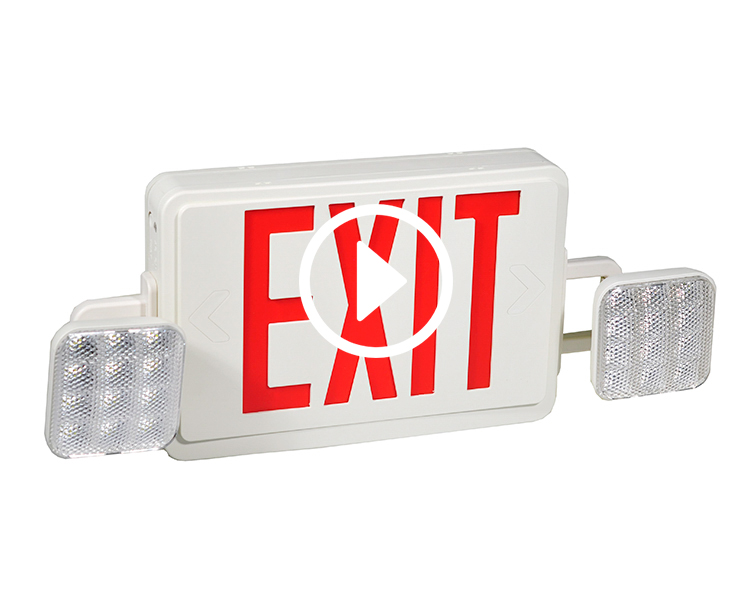 JLEC2RWRC Remote-Capable LED Exit Sign ComboA red-letter exit sign and emergency light combo with remote-head capability and 90-minute backup for maintenance and spare-unit planning.View Product →
A Practical Procurement Checklist
When ordering or specifying exit signs, confirm these items before the purchase order is issued:
- UL 924 listing for the complete sign, not just the LED module.
- 6-inch letters, 3/4-inch stroke, 3/8-inch spacing, and the correct color for the authority having jurisdiction.
- Rated viewing distance that covers the actual mounting layout.
- 90-minute emergency operation from the built-in battery or a central system.
- Enclosure rating for the environment: standard indoor, damp location, or IP65 wet location.
- Directional chevrons, single- or double-face configuration, and mounting height.
- Low-location marking if the occupancy requires it.
- Written test procedure and spare batteries or replacement modules.
For projects that need documented compliance, request the certificate and keep it with the submittal. Our UL E464915 certificate of compliance is one example of the paperwork a reviewer may ask for. For a closer look at how sign visibility affects evacuation, see this discussion of exit sign visibility in low-light escape routes.
The bottom line is straightforward: NFPA 101 exit sign compliance is a set of measurable checks, not a matter of taste. Get the letter size, illumination, spacing, and test records right, and the inspection conversation becomes much shorter.


 NINGBO FEITUO ELECTRIC APPLIANCE CO., LTD.
 0086-574-87387582
 Website: www.ifeituo.com
 info@ifeituo.com
 Mob/WeChat/WhatsApp: 0086-135-6655-7272