Home
Home English
 عربى
عربى Español
 русский
 Français
 中文简体
中文简体Introduction to Twin Spot Emergency Lights
Twin spot emergency lights are essential safety devices used to provide illumination in emergency situations, such as power outages or during evacuations. These lights are commonly found in commercial, industrial, and residential settings where it is crucial to have reliable lighting during emergencies. The primary function of a twin spot emergency light is to offer focused light that helps guide individuals to safety in low visibility conditions. One of the most important aspects to consider when evaluating these lights is their brightness and light coverage area, as both factors determine how effectively the light can illuminate the space during an emergency.
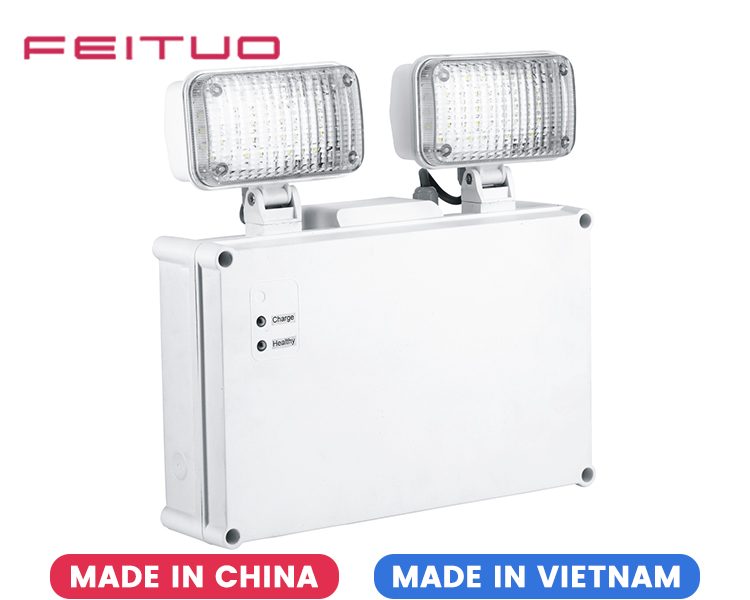
Typical Brightness of a Twin Spot Emergency Light
The brightness of a twin spot emergency light is an important factor in its ability to illuminate an area during an emergency. Brightness is typically measured in lumens, which quantify the total amount of visible light emitted by a source. Twin spot emergency lights typically produce between 100 and 500 lumens per head, depending on the model and its intended application. The exact brightness can vary based on the type of bulb used, whether it is an LED, halogen, or incandescent bulb. LED-based twin spot emergency lights are more common in modern designs due to their energy efficiency and longer lifespan.
The brightness of a twin spot emergency light should be sufficient to ensure visibility in low-light environments. For example, in a hallway or stairwell, a brightness of around 200 lumens per head is usually adequate to provide enough light for safe navigation. However, for larger open areas, such as warehouses or industrial spaces, higher brightness levels may be required to ensure that the light reaches all corners of the room effectively. Typically, high-lumen models can produce up to 1,000 lumens, but these are often used in larger or more complex emergency situations where a higher level of illumination is necessary.
Factors Affecting the Brightness of Twin Spot Emergency Lights
Several factors can affect the overall brightness of a twin spot emergency light, including the type of light source, the design of the reflector, and the power supply. LED lights are favored for their efficiency, as they consume less power while producing more light compared to traditional incandescent or halogen bulbs. The light source's efficiency is key to determining how much light is produced while minimizing energy consumption. Additionally, the design of the reflector or lens plays a role in directing the light where it is needed, enhancing the light output without wasting energy.
Another factor that influences the brightness is the battery capacity. Emergency lights typically rely on rechargeable batteries, and the capacity of the battery determines how long the light will remain illuminated during a power outage. Larger or higher-capacity batteries can support higher-lumen lights for extended periods, ensuring that the light remains functional when it is most needed. The quality of the components, such as the LEDs or reflectors, also impacts the light’s overall brightness and efficiency.
Light Coverage Area of Twin Spot Emergency Lights
The light coverage area refers to the size of the area that a twin spot emergency light can effectively illuminate. This is influenced by several factors, including the brightness of the light, the angle of the light heads, and the specific design of the light fixture. Twin spot emergency lights typically feature adjustable heads, allowing them to provide focused light over a larger area. The typical coverage area for these lights ranges from 15 to 30 square meters (160 to 320 square feet) per light head, depending on the model and the brightness of the light.
For instance, a twin spot emergency light with a brightness of 200 lumens per head may cover an area of approximately 20 square meters, while a higher-lumen model could cover a larger space of up to 30 square meters or more. The spacing between light heads is another important factor in determining coverage. For optimal coverage, the lights should be spaced at regular intervals, ensuring that the illuminated areas overlap slightly to provide continuous light coverage without dark spots.
Factors Affecting the Coverage Area of Twin Spot Emergency Lights
The coverage area of twin spot emergency lights is affected by several factors, including the beam angle, mounting height, and layout of the space being illuminated. The beam angle determines how wide or narrow the light spreads. For example, a narrow beam angle will focus the light on a smaller area, while a wider beam angle can illuminate a larger area. The typical beam angle for twin spot emergency lights is between 30 and 60 degrees, depending on the design.
The height at which the lights are mounted is also crucial for determining coverage. When mounted at higher points, such as ceilings or high walls, the light will cover a larger area. However, if mounted too high, the light intensity may decrease at ground level, making it less effective. For optimal coverage, the lights should be mounted at an appropriate height to ensure that the light reaches all necessary areas without creating shadows or dark spots. In addition to mounting height, the layout of the space being illuminated plays a role in how effectively the light spreads. Large, open spaces may require more powerful lights or multiple units to ensure complete coverage, while smaller or confined spaces may be adequately illuminated by a single twin spot light.
Comparing Twin Spot Emergency Lights to Other Emergency Lighting Options
When considering emergency lighting solutions, it is important to compare the features of twin spot emergency lights with other types of lighting, such as single-head emergency lights or general area lighting. Single-head emergency lights typically provide illumination over a smaller area, making them suitable for narrow hallways or corridors. However, they are not as effective for large rooms or open spaces, where multiple light sources may be needed to ensure adequate coverage.
In comparison, twin spot emergency lights offer more flexibility, with two adjustable heads that can be directed to cover a larger area. This makes them ideal for spaces that require focused lighting in multiple directions, such as large meeting rooms, industrial spaces, or stairwells. The ability to adjust the direction of the light ensures that all areas are adequately illuminated, reducing the risk of dark spots that could pose safety hazards during an emergency.
Another option to consider is general area emergency lighting, which typically uses larger fixtures to provide uniform light across a wide area. While this type of lighting is useful for broad coverage, it may not offer the same level of focused illumination as twin spot lights, which can be directed to specific areas of need. Twin spot emergency lights are often preferred for spaces where precise lighting is required, such as in areas with obstacles, narrow passages, or multiple exits.
Performance and Efficiency of Twin Spot Emergency Lights
In terms of performance, twin spot emergency lights generally offer a good balance of brightness and coverage while being energy-efficient. As mentioned, LED lights are often used in these devices due to their low power consumption and long lifespan. This makes them a cost-effective option for long-term use, as they require less energy to operate and need to be replaced less frequently than traditional light bulbs.
Moreover, twin spot emergency lights are designed to operate efficiently during power outages, maintaining functionality for extended periods with their rechargeable batteries. The performance of these lights is also influenced by the quality of their components, including the LEDs, reflectors, and battery systems. Well-designed twin spot lights are capable of providing reliable performance for several hours in an emergency situation, ensuring that the light remains functional when it is most needed.
Comparison of Brightness and Coverage: A Table
The following table compares the brightness levels and light coverage area of different twin spot emergency lights based on their lumen output and application:
| Model | Brightness (Lumens per Head) | Typical Coverage Area (Square Meters) | Beam Angle |
|---|---|---|---|
| Standard Twin Spot (LED) | 200 | 20 | 30° |
| High Output Twin Spot (LED) | 500 | 30 | 40° |
| Industrial Grade Twin Spot (LED) | 800 | 40 | 60° |
| Halogen Twin Spot | 150 | 15 | 30° |


 NINGBO FEITUO ELECTRIC APPLIANCE CO., LTD.
 0086-574-87387582
 Website: www.ifeituo.com
 info@ifeituo.com
 Mob/WeChat/WhatsApp: 0086-135-6655-7272