Home
Home English
 عربى
عربى Español
 русский
 Français
 中文简体
中文简体Stand at the top of a typical basement stairway: fourteen straight steps and a pull chain at the bottom that you have to reach in the dark. Now make the same trip at night with an armload of laundry, or during a power outage. That is why basement stair lighting is as much about safety as style. The conclusion up front: effective basement stair lighting is layered. One fixture washes the flight with even light, a second outlines every tread edge, and a third runs on battery backup so the stairs never go fully dark.
What Makes Basement Stairs Difficult to Light
Basement stairs concentrate the hardest lighting conditions in a house into a few square feet:
- No daylight. Below-grade stairwells get zero natural light, so the fixtures are the only source.
- Tight geometry. Low headroom rules out pendants, and narrow width makes protruding wall lights hazardous.
- Egress duty. Basement stairs sit on the exit path in almost every building code, which adds emergency lighting requirements.
- Switch code. The NEC and most local codes require wall switches at both the top and bottom of interior stairways.
These constraints push most projects toward a predictable set of fixture types. Every problem has a proven solution; the skill is combining them in the right order.
Set the Baseline: Brightness, Color, and Control
Choose brightness first. Lighting designers measure light in foot-candles (lumens per square foot). Stair treads need 10 to 20 foot-candles (100 to 200 lux) for comfortable depth perception — in practice, 300 to 600 lumens per three or four steps, or one 800+ lumen ceiling fixture for a standard 14-step flight.
| Location | Target illuminance | Typical fixture output |
|---|---|---|
| Stair treads | 10–20 fc (100–200 lux) | 300–600 lm per 3–4 steps |
| Landings | 5–10 fc (50–100 lux) | 200–400 lm |
| Full stairwell wash | 15 fc average | 800–1,200 lm per fixture |
| Basement floor at the base | 10–30 fc | 1,000+ lm |
Color temperature is the second decision. Warm 2700K reads residential, but 3000 to 4000K reveals tread edges more clearly, especially with CRI 90+ LEDs. Use 3000K as the default; choose 4000K for a workshop basement.
Third, decide control. Wire three-way switches at the top and bottom so nobody walks down dark stairs to find the switch. A motion sensor at the top of the stairwell brings the light on automatically as the door opens — a small convenience that matters when your hands are full.
Eight Basement Stairs Lighting Ideas That Actually Work
The eight options below cover every common stairwell layout, and most can be combined.
1. Above-Door Header Light
Mount a surface or adjustable fixture on the wall above the door frame, aimed down the flight. This works when there is no access to the ceiling from above, and it keeps the fixture out of the headroom zone. A gooseneck wall lamp or a small adjustable spot covers the top half of the flight.
2. Wall Sconces on the Stairwell Wall
Low-profile sconces on the long stair wall, spaced every three or four steps, produce even, glare-free light. Hardwired sconces are the durable choice; battery sconces work for rentals. Keep the fixture depth under four inches so the stair width stays comfortable.
3. Recessed Step Lights
Small fixtures set into the riser or stringer aim light directly at each tread — the lowest-glare option and a favorite for modern interiors. Most draw only 1 to 3 watts and double as night lights with a photocell. They also solve the low-headroom problem entirely, because nothing protrudes.
4. Recessed Ceiling Lights
If the ceiling is accessible from above, recessed downlights are the workhorse. Space them four to six feet apart, centered on the path, and use IC-rated airtight trims next to insulation. Choose a battery-backup model so the same downlight keeps working during a power failure; an emergency-rated LED downlight that complies with UL 924 combines everyday illumination with egress lighting in one unit.
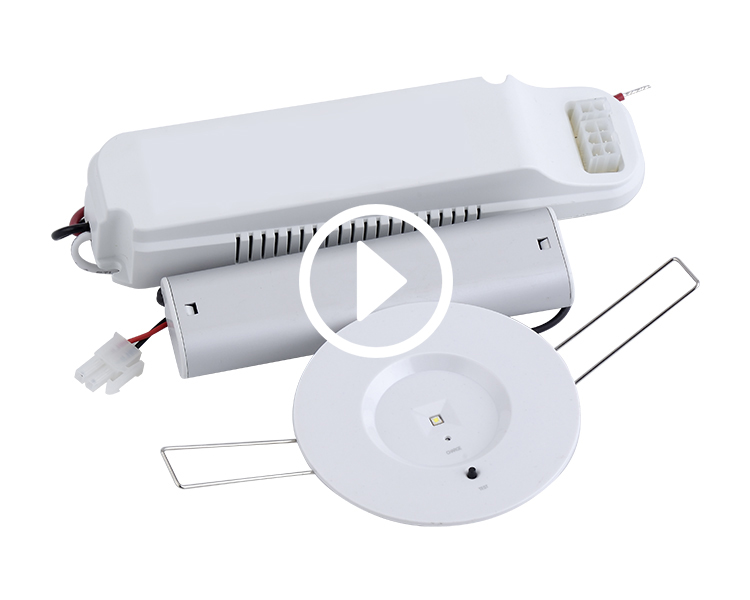 D40-R-1 Recessed Emergency LED Downlight with Battery BackupThis UL 924-compliant downlight suits ceilings with limited space, combining everyday illumination with battery-backed egress lighting. Its thin profile and emergency function make it a practical choice for accessible-ceiling installations.View Product →
5. Low-Profile Flush-Mount Ceiling Fixtures
For very low headroom and no space for recessed housings, ultra-thin LED panels attach directly to the ceiling and protrude less than an inch. They spread light broadly and look clean.
6. LED Strip Lighting
LED strip along the stringer, under the tread nose, or along the underside of the handrail is the most effective way to outline every step. Use a 12V or 24V constant-voltage strip with a matched driver and respect its rated run length to avoid a brightness drop at the far end. In damp stairwells, use an IP65-rated profile.
7. Motion-Sensor and Automatic Lights
A motion-activated fixture at the top of the stairs lights the path the moment the door opens. Battery-powered stick-on motion lights are the quickest no-wiring fix for a rental. If you hardwire a motion switch, pick one with a manual override.
8. Emergency Battery Backup Fixtures
The category most homeowners skip. A dedicated emergency light with an internal battery stays off during normal operation and switches on when AC power drops. A twin-spot emergency light mounted near the bottom of the flight can aim one head up the steps and the other across the landing. In a walk-out basement, a combo exit sign over the exterior door handles exit marking and path lighting at once.
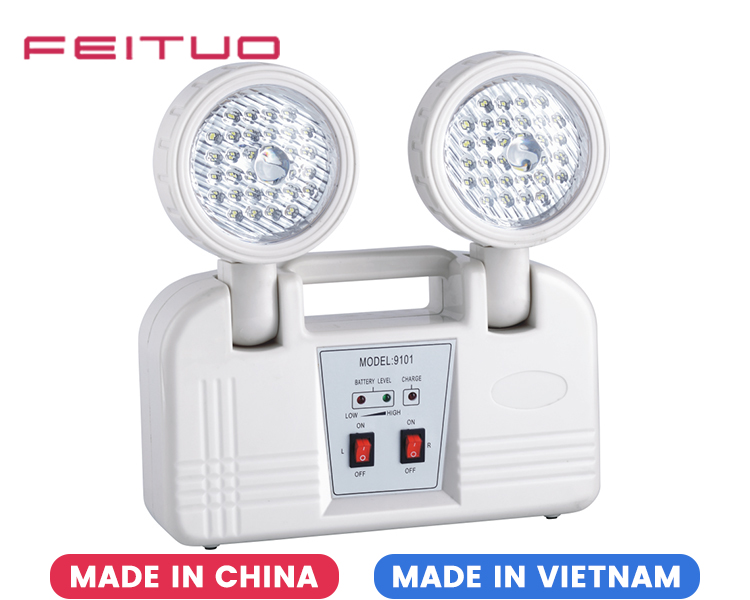 2923 LED Twin Spot Emergency Light with Adjustable HeadsMounted near stair landings, this battery-powered twin-spot light directs beams up the steps and across the landing when AC power fails. It adds a crucial safety layer for basements and egress paths.View Product →
The Emergency Layer: Why Battery Backup Belongs on Basement Stairs
All eight ideas improve daily convenience; the emergency layer protects life. Basements are below grade, so when the power dies, the stairwell is the darkest place in the house. NFPA 101 requires emergency illumination along the path of egress in most commercial, institutional, and multifamily buildings, and many municipal codes extend that duty to habitable basements.
Three takeaways matter when buying or specifying basement stair lighting:
- Use certified emergency fixtures. In North America, look for UL 924 listed equipment; in Europe, EN 60598-2-22 applies. An uncertified fixture can fail an inspection — and worse, it can fail when you need it most.
- Check the battery and the driver. Nickel-cadmium and nickel-metal-hydride tolerate cold and cycling well; lead-acid costs less but wears out sooner. A 90-minute runtime is the egress benchmark in most codes, and the trade-offs are the same ones covered in this explainer on the science behind LED emergency lights.
- Verify the certification documents before purchase. Reputable manufacturers publish them openly — for example, the UL E464915 certificate for FEITUO's emergency lighting line — and a five-minute check prevents counterfeit hardware from entering your project.
Where code requires a visible exit sign, a combo unit with LED signage and integrated heads satisfies both requirements in one junction box.
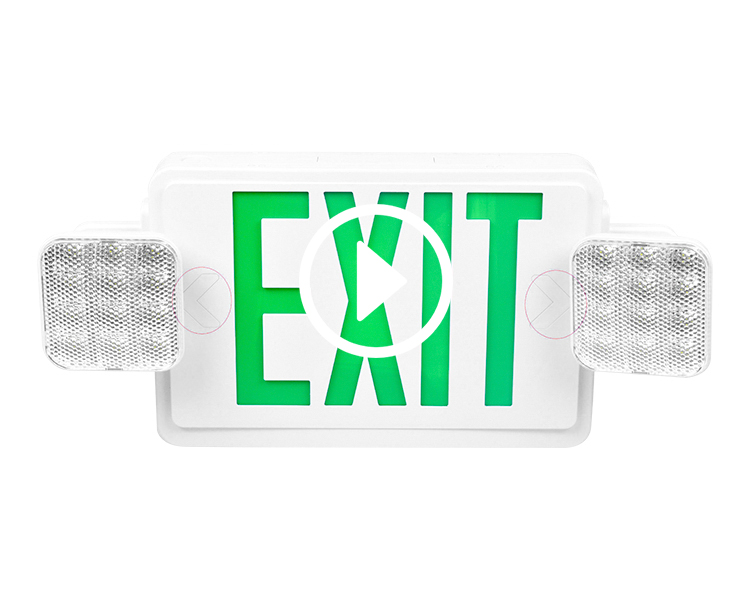 JLEC2GW-LED Combo Exit Sign and Emergency LightThis 2-in-1 unit provides visible green exit signage plus integrated emergency heads in one junction box. UL-listed and code-compliant, it covers exit marking and path lighting for commercial and multifamily spaces.View Product →
Comparison at a Glance
| Idea | Best for | Power source | Installation effort | Relative cost |
|---|---|---|---|---|
| Above-door header light | No ceiling access | Hardwired or plug-in | Low to moderate | Low |
| Wall sconces | Even path light | Hardwired or battery | Low | Low to medium |
| Recessed step lights | Low headroom, modern look | Hardwired low-voltage | Moderate | Medium |
| Recessed ceiling lights | Full wash, code-friendly | Hardwired, battery option | High | Medium to high |
| Flush-mount ceiling fixture | Very low ceilings | Hardwired | Low | Low to medium |
| LED strip lighting | Step outline, ambiance | 12/24V driver | Moderate | Low to medium |
| Motion-sensor lights | Hands-full use, rentals | Battery or hardwired | Very low | Low |
| Emergency backup fixtures | Outages, egress code | Hardwired with battery | Moderate | Medium to high |
A Simple Decision Path
Use this sequence to reduce the eight ideas to a working combination:
- Ceiling accessible from above? Start with recessed downlights (Idea 4); otherwise use a flush-mount (Idea 5) or header light (Idea 1).
- Headroom below 6 feet 8 inches? Skip protruding fixtures; use step lights (Idea 3) or strips (Idea 6).
- No wiring allowed? Use battery sconces (Idea 2) and motion lights (Idea 7).
- Stairs end at an exterior door? Add a combo exit sign (Idea 8).
- Always finish with the non-negotiable layer: at least one battery-backup fixture per stairwell.
Common Mistakes and How to Avoid Them
- One switch only forces someone to walk dark stairs every day. Wire three-way.
- Fixtures too dim. A 300-lumen unit fails on a 14-step flight. Calculate by foot-candles, not wattage.
- Glare at eye level. Sconces mounted too high shine into descending eyes. Keep sources low or use diffused lenses.
- Cans spaced too far. Pools of light with dark gaps defeat the purpose. Space four feet apart and test first.
- Skipping emergency code. If NFPA 101 or local egress rules apply, a battery-backup fixture is mandatory.
- Ignoring damp ratings. Dry-location-only fixtures corrode and fail early.
Bottom Line
Start with the baseline decisions — brightness, color temperature, and three-way switches — then layer three things: a general fixture for the whole flight, a step-level source that defines each tread, and an emergency backup unit. For most homes that means a battery-backup downlight near the top, LED strip or step lights along the treads, and a twin-spot head at the bottom. It is a combination that works for the daily trip and for the one night a year the power dies.
Contractors and specifiers who source under their own brand can cover all three layers as OEM products; FEITUO's OEM catalog spans dual-head, downlight, and exit-sign configurations with UL, CE, and RoHS compliance options.


 NINGBO FEITUO ELECTRIC APPLIANCE CO., LTD.
 0086-574-87387582
 Website: www.ifeituo.com
 info@ifeituo.com
 Mob/WeChat/WhatsApp: 0086-135-6655-7272