Home
Home English
 عربى
عربى Español
 русский
 Français
 中文简体
中文简体Finding a dark exit sign during a routine building walk-through is never a small problem. The inspection is coming, the code has been violated, and every occupant of that floor is relying on a unit that failed silently. An emergency exit light looks like a commodity product, but the decision of which unit to buy and how to verify it affects inspection results, insurance claims, and ultimately the safety of everyone in the building. This guide explains what these fixtures do, which standards control them, and how to avoid the mistakes that surface only after installation.
What Is an Emergency Exit Light?
An emergency exit light is a battery-backed fixture that takes over automatically when normal mains power fails. The term covers three distinct configurations: an exit sign that marks the escape route, an emergency luminaire that illuminates the path, and a combination unit that performs both functions in one housing.
Exit signs display a directional legend, usually the word EXIT or the running-man pictogram, and must stay visible in total darkness. Emergency luminaires cast light across corridors, stairwells, and open areas so occupants can see where they are stepping. Modern LED designs have made combination units common because one battery, one driver, and one mounting point cover both duties.
Every configuration shares the same operating principle. Under normal supply the internal battery remains charged; when power is interrupted, the control circuit switches the LED load to the battery for a specific discharge period. The industry benchmark is 90 minutes of runtime, which matches the minimum egress illumination requirement in most building codes. A quality unit restores its full charge automatically after a discharge and is ready for the next interruption within 24 hours.
For small lobbies, single-door exits, and retail stores where wall space is limited, a green LED emergency exit sign with integrated light heads consolidates marking and illumination into one maintenance point.
Codes and Certifications That Decide Whether a Unit Passes Inspection
Emergency exit lights are not decorative accessories. In the United States, NFPA 101 and OSHA regulations require exit routes to be illuminated and marked with approved units; in Europe, the EN 1838 standard on emergency lighting and national building codes impose equivalent duties. On the product side, UL 924 governs emergency lighting and exit sign equipment in North America, while CE marking and RoHS compliance are expected for European projects.
Certification is treated by inspectors as the first line of evidence. A UL-listed fixture has passed construction review and performance testing, including light output, battery discharge, and voltage endurance, under an independent third-party program. If a non-listed unit appears in a new building, inspectors commonly flag it simply because verification is impossible on site. Insurance companies have been known to dispute claims where uncertified egress lighting was part of the system.
Manufacturers who maintain a current listing file can provide the exact documentation inspectors ask for, such as a UL E464915 certificate of compliance. Testing frequency is another requirement that buyers often underestimate. Most codes ask for a monthly functional test of at least 30 seconds and an annual full-duration test of 90 minutes. Units with self-test and self-diagnostic features record the results automatically and reduce the cost of manual testing in multi-floor buildings.
A UL-approved 6-inch LED exit sign gives facility owners documented proof of compliance that can be shown to an inspector before a question is asked. For background on how certification and testing frameworks fit together, the emergency lighting knowledge hub covers rating systems, battery behaviour, and compliance strategy in more detail.
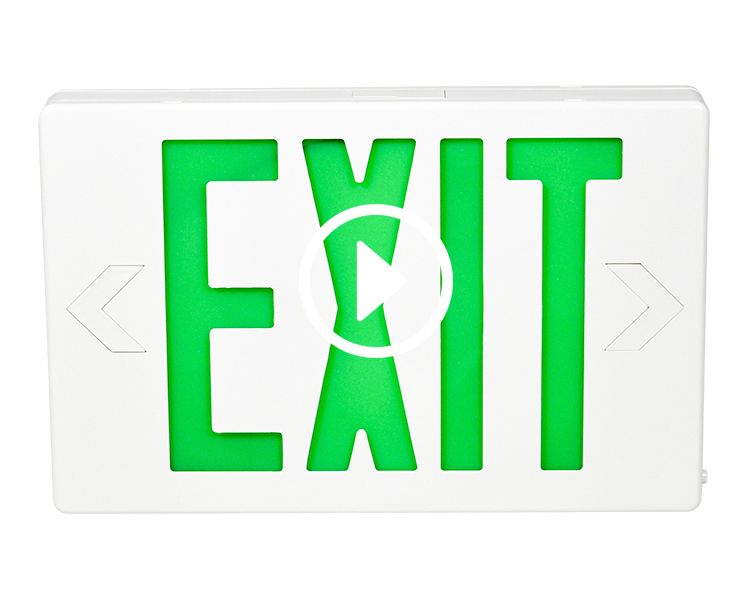 Wholesale JEE2GWE-6 Inch Ul Approved Green Exit Signs Suppliers, Factory - NingbNingbo FEITUO Electric Appliance Co., Ltd. is China wholesale JEE2GWE-6 Inch Ul Approved Green Exit Signs suppliers and factory,6 Inch UL...View Product →
The Main Types of Emergency Exit Lights
Choosing the right form factor depends on the building layout, ceiling height, distance to the exit, and whether the area keeps its normal lighting during a failure. The table below summarises the most common configurations.
| Type | Best Use | Mounting | Power Source |
|---|---|---|---|
| Standalone exit sign | Marking doors and exit path endpoints | Wall, ceiling, pendant | Internal battery |
| Emergency twin-head luminaire | Corridors, stairwells, plant rooms | Wall or ceiling | Internal battery |
| Combination sign and light heads | Lobbies, single-point exits, retail | Wall or ceiling | One internal battery for both |
| Remote head system | Large floors with centralised power | Power unit remote; lamp heads placed separately | Central battery or inverter |
| Waterproof bulkhead light | Outdoor routes, car parks, washdown areas | Wall or ceiling | Internal battery, IP65 housing |
The twin-head emergency luminaire remains the most widely installed configuration because its adjustable heads allow the beams to be aimed along a corridor or toward stair heads and equipment. A UL-approved twin-head LED emergency light typically provides the full 90-minute runtime while keeping the housing small enough to sit flush against a wall.
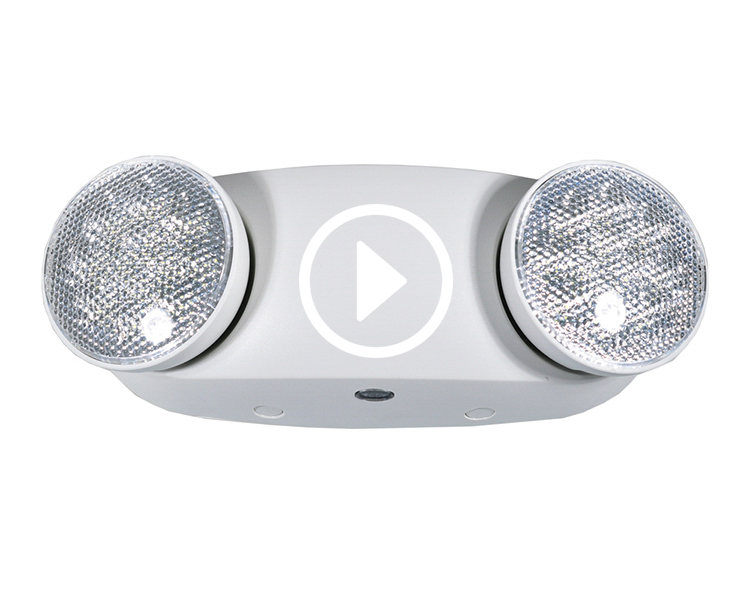 Wholesale JLEU5-UL Approved Twin Head LED Emergency Light Suppliers, Factory - Ningbo FEITUO Electric Appliance Co., Ltd. is China wholesale JLEU5-UL Approved Twin Head LED Emergency Light suppliers and factory,UL A...View Product →
Beyond these, waterproof bulkhead units rated IP65 handle rain, humidity, and pressure washing, making them the default outside loading bays and in underground car parks. Emergency downlights disappear into concrete or plaster ceilings and suit offices and hotels, while remote lamp heads separate the power unit from the light source so the battery can be maintained in an accessible location.
Five Specifications to Check Before You Order
Once the configuration is clear, five specifications decide whether the unit will perform in its actual environment.
Illumination output
For egress paths, most codes specify at least 1 foot-candle (10.8 lux) average illumination at floor level, with a stated minimum at any point. Exit sign legends must remain legible from the required viewing distance, commonly 100 feet (30 m). When comparing products, check the real lumen output of the LED module, not just the wattage, because LED output drifts as the unit ages.
Battery chemistry and capacity
NiCd, NiMH, lead-acid, and Li-ion cells appear across product ranges. NiCd tolerates deep discharges and cold temperatures well; lead-acid offers low cost; Li-ion delivers high energy density in a smaller footprint. Confirm that the battery is replaceable on site, and ask for the replacement cell part number before you commit to a large order.
Housing, ingress protection, and environment
An ABS or polycarbonate housing suits dry indoor areas. Steel housings resist impact in warehouses and industrial plants. For outdoor, parking garage, or washdown installations, an IP65-rated unit prevents moisture from reaching the battery and driver. Check the operating temperature range, especially for unheated stairwells and canopies.
Mains voltage and wiring
Most units accept 120V or 220-240V, but some market-specific versions are fixed at one voltage. Verify the input voltage against the project specification before ordering in bulk; mixed-voltage deliveries are one of the most common field problems on larger projects.
Test and monitoring features
Self-test models run the 30-second and 90-minute cycles automatically and indicate failures with an LED or buzzer. In buildings with dozens or hundreds of units, this feature reduces inspection labour more than any other option.
Four Procurement Mistakes That Show Up Later
Even experienced contractors repeat a few predictable errors.
Buying on price alone. Uncertified units look identical in product photos, but the differences appear in lumen output, battery capacity, and plastic quality. A failed inspection or a dead battery inside the warranty period usually costs more than the original saving.
Ignoring the installation environment. An indoor-rated unit installed under a canopy or in a semi-open corridor will fail prematurely. Match the IP rating and housing material to the real location, not to the drawing description.
Forgetting service access. If the battery is glued in place, the lens cannot be opened, or the wiring requires full disassembly, technicians will not test the unit as often as they should. Specify fixtures that can be serviced in place.
Mixing voltages in one project. A simple line item in the tender specification prevents the most common field fault: a 220-240V fixture connected to a 120V circuit, or vice versa. Verify every unit against the site supply before installation.
Sourcing Emergency Exit Lights for Volume Projects
For distributors, electrical contractors, and facility owners buying quantities, the fixture is only one part of the decision. The manufacturer's production depth, certification support, and willingness to adapt a product to local requirements matter just as much.
A factory that controls injection moulding, metal stamping, transformer winding, SMT assembly, and final testing under one roof can respond faster to custom specifications and keeps quality consistent from batch to batch. ISO9001 quality management, UL certification files, and documented test reports turn a purchase order into a defensible procurement decision. Ningbo FEITUO Electric Appliance Co., Ltd. has manufactured emergency lighting and exit signs for over 20 years, offers OEM and ODM support from custom sign faces to complete product specifications, and confirms quotations within 24 hours. Warranty coverage extends up to five years on electrical components and housings, with three years on batteries.
An emergency exit light is ultimately a risk-management purchase. Understand the code requirement, verify the certification with a listed product, match the type and environment, and source from a manufacturer that stands behind its hardware. That sequence keeps a building passable at inspection time and keeps occupants safe when the lights go out.


 NINGBO FEITUO ELECTRIC APPLIANCE CO., LTD.
 0086-574-87387582
 Website: www.ifeituo.com
 info@ifeituo.com
 Mob/WeChat/WhatsApp: 0086-135-6655-7272