Home
Home English
 عربى
عربى Español
 русский
 Français
 中文简体
中文简体When a building loses power at 6:47 pm, the emergency lighting should already be on. Not three seconds later. Not when someone finds a torch. Immediately. That expectation is not a luxury design choice; it is built into fire and life safety codes across North America, Europe, and much of Asia. For facility managers, electrical contractors, and lighting importers, the real question is not whether to install emergency lighting for power outages, but which specification package delivers dependable illumination at a defensible cost.
The gap between a routine blackout and a serious incident is often a corridor lit well enough to keep people calm and moving. Emergency lighting for power outages exists to fill exactly that gap between mains failure and either power restoration or evacuation. Understanding how a fixture works, what it contains, and where it fails helps buyers avoid the sourcing mistakes that turn a code-compliant purchase into a future liability.
Why Emergency Lighting Matters During Power Outages
The purpose is not just visibility; it is legal compliance and occupant safety. In the United States, NFPA 101 (Life Safety Code) requires means of egress to be illuminated during a power failure, and OSHA applies similar expectations in workplaces. In the European Union, EN 1838 defines minimum illumination levels for escape routes and open areas. These codes share a common requirement: emergency lighting must activate automatically when normal power is lost, typically within one second.
That makes self-starting capability a non-negotiable feature, not an optional extra. Fixtures that combine a battery, charger, and automatic transfer circuit in a single housing reduce the number of failure points. A dual-head or twin-spot emergency light that switches itself on the moment line power drops remains the most widely used solution for a simple reason: it is proven. As this analysis of self-starting twin-spot emergency lights explains, transfer time is one of the first details a specifier should verify.
Light output is the complementary consideration. NFPA 101 permits as little as 1 foot-candle (about 10.8 lux) along an egress path, while EN 1838 asks for at least 1 lux on the centerline of an escape route. Whichever code governs your project, specifying a fixture that delivers comfortably above the floor threshold is wise, because the measured illumination declines as the battery discharges over the required 90-minute duration.
Key Specifications to Check Before Buying
Not all emergency lighting for power outages is equal on paper, and the differences show up in the field. When you evaluate a unit, start with five numbers.
- Battery backup duration. Most codes require 90 minutes. Hospitals, high-rise towers, and certain industrial occupancies may call for 120 or even 180 minutes.
- Power rating and lumen output. LED dual-head fixtures commonly run from 5 W to 12 W total. Higher wattage provides more coverage in large open areas.
- Battery chemistry and capacity. Nickel-cadmium, sealed lead-acid, and lithium-ion dominate. The choice affects runtime, operating temperature, maintenance, and replacement cost.
- Housing material and ingress protection. ABS and steel are the norm. For wet or dusty sites, an IP65-rated bulkhead housing is the practical baseline.
- Certification marks. UL/cUL, CE, RoHS, or regional equivalents must be verifiable through a certificate and test report, not merely printed on the label.
These numbers determine both the purchase price and the legal validity of the fixture in a given project. For an importer comparing quotes, every dollar saved by choosing an undocumented factory can reappear as a larger cost in lab testing, rework, or rejected shipments.
Why Battery Chemistry Decides the Maintenance Budget
Battery choice is the most consequential decision in the whole specification. NiCd cells tolerate temperature extremes and survive hundreds of charge/discharge cycles, but their energy density is lower and disposal is regulated. Sealed lead-acid batteries are inexpensive and dependable at moderate temperatures, which is why most commercial units still use them. Lithium-ion packs are lighter and hold a charge much longer between maintenance intervals, an important advantage for fixtures that sit idle for weeks before an outage occurs.
Common Types of Emergency Lighting for Power Outages
The right product family depends on the building layout and the failure scenario. The table below summarizes the most common categories.
| Type | Typical application | Mounting | Key advantage |
|---|---|---|---|
| Dual-head / twin-spot | Corridors, storage areas, open offices | Wall | Wide adjustable beam, instant activation |
| Bulkhead (waterproof) | Outdoor passages, parking garages, washdown areas | Wall or ceiling | IP65 protection against dust and moisture |
| Emergency downlight | Lobbies, meeting rooms, recessed ceilings | Recessed | Preserves the architectural ceiling design |
| Exit sign with heads | Escape routes, stairwells, doorways | Wall or ceiling | Combines wayfinding sign and area lighting |
| Portable rechargeable | Homes, inspection work, temporary setups | Handheld / hook | Zero installation cost, high flexibility |
For most corridors and general areas, a dual-head fixture with adjustable lamp heads is the workhorse. If the installation site is wet or outdoors, choose a waterproof bulkhead luminaire with an IP65 housing instead of relying on a standard indoor unit. A 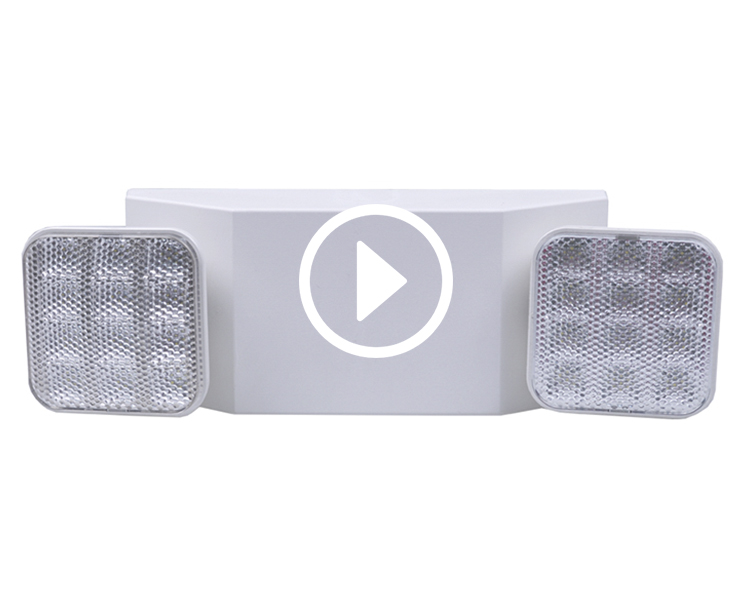 UL/cUL Listed Dual-Head Emergency Light with NiCad BatteryA dependable dual-head emergency light for corridors and general areas, rated for 120/277 VAC with a long-lasting NiCad battery. Its UL listing and compliance documentation suit contractors needing clear inspection paperwork.View Product → UL/cUL-listed dual-head model with documented compliance certificates gives the contractor or importer a clean paper trail for the local authority having jurisdiction.
For architects who do not want visible fixtures interrupting a finished ceiling, an LED emergency downlight that fits a standard recessed opening serves as a normal luminaire while mains is present and switches to battery power when it drops. Stairwells and exit paths benefit from an exit sign with integral lamp heads, since one product provides wayfinding and path illumination simultaneously. These combination units are widely used in hotels, retail spaces, and industrial plants because they reduce the total fixture count and the number of inspection points.
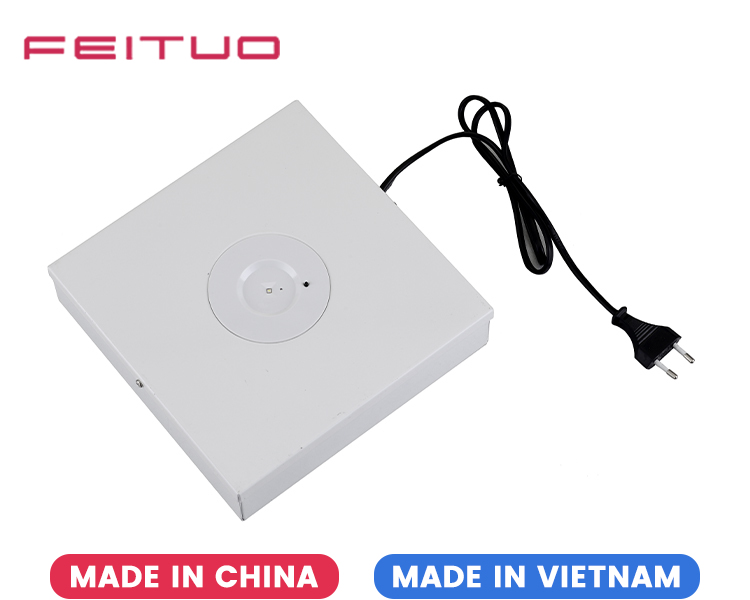 Recessed LED Emergency Downlight with Ni-MH BatteryThis LED downlight fits standard recessed openings, blending with finished ceilings while providing emergency illumination during power loss. With a 4.8V 2.1Ah Ni-MH battery, it suits maintained and non-maintained operation in commercial spaces.View Product →
Battery Chemistry: What Changes Your Runtime and Cost
Battery replacement is often the hidden variable in the total cost of ownership. The first replacement cycle for a commercial emergency light usually arrives within three to five years, and an obscure cell size can cost more than the original fixture. Buying from a manufacturer that produces batteries in-house, or sources them through a controlled supply chain, is a genuine procurement advantage.
| Parameter | NiCd | Sealed lead-acid | Li-ion |
|---|---|---|---|
| Energy density | Medium | Low | High |
| Low-temperature performance | Very good | Reduced below 0 °C | Good down to −10 °C |
| Typical cycle life | 500–1000 | 200–500 | 500–1000 |
| Common formats | 3.6 V / 9.6 V packs | 4 V / 6 V blocks | 3.7 V cells |
| Maintenance burden | Medium | Low | Lowest |
For most commercial projects, a sealed 6 V 4 Ah lead-acid battery inside a well-built dual-head fixture remains the most cost-effective combination. It holds enough energy for 90 minutes of LED illumination, tolerates float charging well, and is inexpensive to replace.
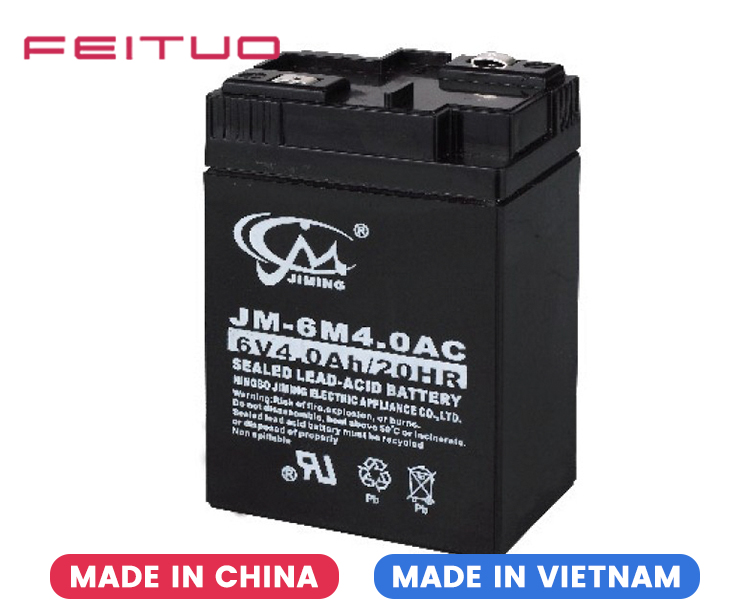 Sealed Lead-Acid Battery 6V 4Ah for Emergency FixturesA cost-effective, sealed 6V 4Ah lead-acid battery designed for dual-head emergency fixtures. It supports 90 minutes of LED runtime and float charging, making it easy to replace and maintain across commercial projects.View Product →
If the fixture will operate in a cold warehouse or an exterior housing with strong solar gain, NiCd chemistry is historically the safer choice. Lithium-ion is increasingly attractive for slim fixtures and for products where weight or shelf life matters, but the charger must be matched to the cell chemistry. A generic charger designed for lead-acid must never be used on a lithium pack.
Certifications You Cannot Ignore
A fixture's certifications are what make it legal to install. On a construction site, the inspector looks not for a handsome housing, but for the listing mark and the documentation behind it.
- UL/cUL. UL 924 is the dominant safety standard for emergency lighting and exit signs in North America. It covers photometric performance, battery charging behavior, and endurance.
- CE marking. CE indicates conformity with applicable EU directives on electromagnetic compatibility and low-voltage safety. Since CE is in part self-declared, always request the test report.
- RoHS. Restriction of hazardous substances is a compliance baseline for electronics in Europe and several other regions.
- IP rating. Not a legal certification, but a clear statement of dust and water resistance. IP65 is the usual threshold for wet or outdoor areas.
For a buyer, the strongest signal is a manufacturer that publishes its compliance certificates rather than waiting to be asked. The same logic applies to components: understanding the difference between an emergency ballast and a regular ballast matters because an emergency driver is what converts an ordinary LED luminaire into an outage-capable fixture, and an uncertified driver can invalidate the whole assembly.
Sourcing Emergency Lighting from a Vertical Manufacturer
The sourcing decision goes beyond the lowest unit price. What matters is whether the factory can back its data sheet with real engineering and production capability. A manufacturer that has spent more than two decades in emergency lighting and runs its own injection molding, SMT lines, transformer winding, and battery assembly can control quality across the components that matter most: the battery pack, the PCB, the charger circuit, and the housing.
Before sending a purchase order, ask these five questions.
- Do you hold valid UL and CE certificates for this exact model, and can you share the report?
- What are the battery replacement policy and the warranty terms? A three-year battery warranty with up to five years on electronics is a solid baseline.
- Do you support OEM customization of housing color, logo, wattage, and battery capacity?
- What is the measured transfer time when mains power fails?
- Can you deliver compliance documentation in the language of the destination market?
A supplier that answers all five without a chain of follow-up emails is rare. That capability, not the number of SKUs on a website, is what separates a manufacturer from a trading company.
The bottom line is straightforward. Emergency lighting for power outages is a regulated, safety-critical product category. Whether you are importing for a distribution channel or specifying for a construction project, the battery chemistry, certification, and transfer behavior of a fixture determine whether it performs when the grid fails. Match the product family to the building's geometry and risk profile, verify the paperwork, and work with a factory that controls the manufacturing steps in-house. That combination is the difference between a light that impresses on paper and a light that actually works in the dark.


 NINGBO FEITUO ELECTRIC APPLIANCE CO., LTD.
 0086-574-87387582
 Website: www.ifeituo.com
 info@ifeituo.com
 Mob/WeChat/WhatsApp: 0086-135-6655-7272