Home
 English
 عربى
 Español
 русский
 Français
 中文简体
Power goes out in a shopping mall corridor at 9:15 p.m. Shoppers pause, but the route to the exit remains visible: twin-head lights near the doors are on, and the green exit signs have not flickered. This happens because an emergency lighting system constantly monitors the mains supply and instantly switches to a backup source when it fails.
At its core, emergency lighting works by pairing a light source with a rechargeable battery or central power supply, plus a control circuit that senses mains failure. When normal power drops, the circuit routes battery power to the luminaires, giving people enough light to leave quickly and safely.
The Core Components of an Emergency Light
Every emergency luminaire relies on four basic building blocks:
- Light source: LED chips, a fluorescent tube, or in older units an incandescent bulb. LED has become dominant because it delivers more light per watt and lasts longer.
- Power backup: a rechargeable battery pack (NiCd, NiMH, Li-ion, or lead-acid) inside each self-contained unit, or a central bank of batteries feeding multiple fixtures.
- Control and charging circuit: this manages charging during normal condition, detects loss of AC power, and changes the connection from mains to battery.
- Test and status interface: a small indicator LED, test button, or remote monitoring port that shows whether the unit is charging and whether the lamp would turn on in an emergency.
In a typical self-contained LED emergency light, these parts are integrated into one housing. The control board continuously charges the battery when mains is present; when the AC supply fails, the board switches the load to the battery and drives the LED at a constant current.
 JLEU1 Dual Head LED Emergency Light with Adjustable HeadsThis wall-mounted unit combines dual adjustable LED heads, a 3.6V NiCd battery, and UL 924 compliance, making it a practical self-contained choice for reliable emergency illumination.View Product →
Self-Contained vs Central Battery Systems
Emergency lighting can be arranged in two broad architectures. The choice affects installation cost, fault isolation, and maintenance labour.
| Feature | Self-contained | Central battery |
|---|---|---|
| Battery location | Inside each fixture | In a central plant room or cabinet |
| Installation | Simpler; no extra cabling | Needs a dedicated switchboard and special wiring |
| Maintenance | Check each unit individually | Service one battery bank in one location |
| Typical applications | Small buildings, shops, offices | Large complexes, cinemas, warehouses |
| Relative cost | Higher per-unit cost | Higher infrastructure cost, but centralized testing can save labour |
Self-contained units are easier to retrofit and replace one by one. Central systems keep all battery maintenance in one place, but a fault in the battery bank can affect a whole floor of luminaires.
How the Switchover Happens
Most self-contained emergency fixtures follow the same operating cycle:
- During normal power, the AC supply powers a rectifier or charger. The battery is held at its float voltage and kept ready.
- If the incoming mains voltage falls or is interrupted, the relay or electronic switch in the control circuit opens the mains path and closes the battery path.
- The battery supplies DC power to an LED driver or directly to the lamp. A constant-current design keeps the light output stable even as battery voltage starts to drop.
- When mains returns, the control circuit switches back to AC, and the battery recharges for the next event.
The switchover is intentionally fast. Safety codes commonly require transfer within a few seconds; many fixtures land well under 1 second, avoiding a disorienting blackout. In fixtures that use an external emergency driver, the difference between an emergency ballast and a regular ballast becomes important, because the emergency version must handle both charging and switching duties.
Maintained and Non-Maintained Operation
An emergency luminaire can be wired to behave in one of two ways:
- Maintained: The lamp is always on when the mains supply is present, and it continues to illuminate from battery when power fails. Exit signs typically run in this mode because the sign must be visible at all times.
- Non-maintained: The lamp stays off during normal operation and only lights up when the mains supply is interrupted. This saves energy and is common for twin-head spotlights and bulkhead units that are not part of everyday lighting.
Many fixtures offer both modes through a switch or a different wiring connection, so the installation team can match the room's occupancy and lighting plan.
Battery Types and Real Lifespan
Battery chemistry determines how long an emergency light can provide illumination, how often it needs to be tested, and when the battery has to be replaced. Sealed lead-acid batteries are still common in high-output twin-head units because they deliver good surge current at a low cost. Nickel-cadmium (NiCd) cells handle low temperatures well and survive many charge/discharge cycles, which makes them popular in exit signs and small emergency lanterns. Nickel-metal hydride (NiMH) offers a moderate capacity boost, while lithium-ion (Li-ion) appears in newer compact fixtures where space and weight are limited.
The chart below shows indicative cycle life figures for these four chemistries. Real-world values vary with depth of discharge, operating temperature, and charger quality.
In practice, a battery that is deep-cycled during frequent tests will age faster than one that only runs during a monthly functional test. Manufacturers commonly recommend replacing emergency light batteries every 3 to 4 years as preventive maintenance. The battery must be large enough to power the connected luminaire for the rated duration, which is often 90 minutes in UL 924 applications and can be 180 minutes in some European specifications. When sourcing spare parts, verify the voltage, capacity, and charge time. A 3.6V NiCd battery might be adequate for a compact exit sign, while a 6V 4Ah lead-acid battery is better for a high-output twin-head unit.
 3.6V 1000mAh Ni-Cad Battery for Emergency LightingA compatible replacement battery for compact exit signs and emergency lights, offering the specified voltage and capacity needed to maintain rated runtime during outages.View Product →
Exit Signs and Directional Luminaires
Exit signs are a specialized part of an emergency lighting system. They run in maintained mode because they must be visible at every moment, including a power failure. Internally, they work like other self-contained emergency lights: an LED array, a small battery, and a charging circuit that switches over when mains is lost.
Directional signs use an arrow or a running-man symbol to guide occupants toward an escape route. Some models combine the sign with one or two LED heads, providing both orientation and general illumination in one fixture. This is common at corridors and above doorways where space is limited.
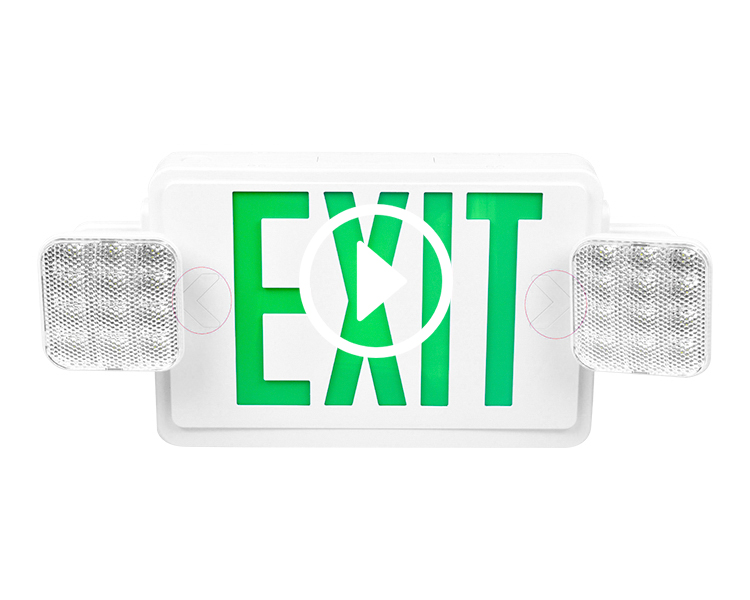 JLEC2GW Combo Exit Sign with Emergency Light and Green LettersThis 2-in-1 fixture integrates directional exit signage with adjustable LED heads, a 9.6V battery, and UL listing—ideal for corridors and doorways needing both guidance and illumination.View Product →
Testing, Maintenance, and Compliance
Visual indicators give a quick health check. A green LED on a self-contained unit usually means the battery is charging and the control circuit does not see a fault. If the green LED is off or blinking, the fixture needs service. A test button simulates a mains failure, forcing the unit to switch to battery for a few seconds. Larger buildings can use remote test switches or centralized monitoring to trigger the same routine from one controller.
Codes and standards set the testing frequency. In many jurisdictions, you should do a short functional test every month and a full-duration discharge test once a year. During the annual test, the battery is allowed to run down to its rated duration; this confirms both the switchover and the actual battery capacity.
When you buy from a manufacturer, ask for documentation that ties the product model to the applicable standard. UL 924 is the common North American benchmark for emergency lighting, while EN 50172 and EN 60598-2-22 are widely used in Europe. Many suppliers make these certificates public; for example, you can inspect one UL compliance certificate for LED emergency lighting directly on the manufacturer's website.
What to Check When Buying Emergency Lighting
Take a practical view when choosing a fixture. IP rating matters for the surrounding environment: an IP65-rated bulkhead or twin-head unit is suitable for a car park or a covered external walkway, while an IP20 fixture belongs in a dry office corridor. Housing material affects corrosion resistance and mechanical durability; ABS and polycarbonate are lightweight and rust-proof, while steel is stronger in industrial environments.
Locations also drive the layout. Stairwells, exit doorways, corridors, and open areas above a certain floor area usually need some form of emergency light or sign. A lighting designer should place luminaires so that every decision point has a visible indication of the exit route.
Finally, compare the total cost, not just the purchase price. A slightly more expensive fixture with a metal housing and a high-temperature battery may keep its performance after years of ceiling heat, reducing labour and replacement costs. The same logic applies to emergency drivers: match the input voltage, output wattage, and battery type to the luminaire you are energizing.
Emergency lighting is not a mysterious product; it is a simple, reliable power path that changes from AC to DC when the mains disappears. The light source, battery, control circuit, and visual indicator work together to keep escape routes visible and give occupants confidence during an evacuation. Whether you choose self-contained units for a small office or a central battery plant for a large facility, the fundamental principle stays the same: detect the failure, switch the power source, and keep the lights on.


 NINGBO FEITUO ELECTRIC APPLIANCE CO., LTD.
 0086-574-87387582
 Website: www.ifeituo.com
 info@ifeituo.com
 Mob/WeChat/WhatsApp: 0086-135-6655-7272