Home
 English
 عربى
 Español
 русский
 Français
 中文简体
An inspector stops at a stairwell door, cuts normal power, and starts a stopwatch. The exit sign stays lit. The corridor fixture holds. Ninety minutes later, the light level at the floor is checked again. That scene is what NFPA 101 emergency lighting compliance looks like in practice.
The Life Safety Code sets performance outcomes, testing routines, and documentation duties. It does not sell a fixture, and it does not accept a catalog claim as proof. Treat NFPA 101 as a system requirement: power source, fixture placement, illumination, exit marking, and maintenance all have to work together.
What NFPA 101 Actually Requires for Emergency Lighting
Section 7.9 of NFPA 101 addresses emergency lighting for means of egress. The core requirement is simple to state and harder to verify: if normal lighting fails, emergency illumination must come on automatically and remain available for not less than 1.5 hours.
The code also sets measurable light levels. Along the path of egress, at floor level, initial illumination must average at least 1 fc, with no point below 0.1 fc. By the end of the 1.5-hour test, the average may decline to 0.6 fc and the minimum to 0.06 fc. Those numbers matter because a fixture that looks bright on a desk can still fail a floor-level measurement after battery aging, voltage drop, or a long remote-head run.
NFPA 101 also expects emergency lighting in designated stairs, aisles, corridors, ramps, escalators, passageways leading to an exit, and exit discharge where required. Battery-operated electric lights are permitted as an emergency source, but the installation still has to be listed, labeled, and acceptable to the authority having jurisdiction.
| Checkpoint | NFPA 101 expectation |
|---|---|
| Power duration | Not less than 1.5 hours after failure of normal lighting. |
| Initial average | 1 fc (about 10.8 lux) along the path of egress at floor level. |
| Initial minimum | 0.1 fc (about 1.1 lux) at any measured point. |
| End-of-test average | 0.6 fc (about 6.5 lux) at 1.5 hours. |
| End-of-test minimum | 0.06 fc (about 0.65 lux) at 1.5 hours. |
| Activation | Automatic on interruption of normal lighting. |
| Monthly test | Not less than 30 seconds. |
| Annual test | Not less than 1.5 hours. |
| Records | Written test records available to the authority having jurisdiction. |
In North America, specifiers commonly look for UL 924 listing for emergency lighting and exit signs; the code requires listed equipment, while UL 924 is a separate product-safety benchmark. A UL-listed twin-head unit is a practical example of the fixture category used on egress paths.
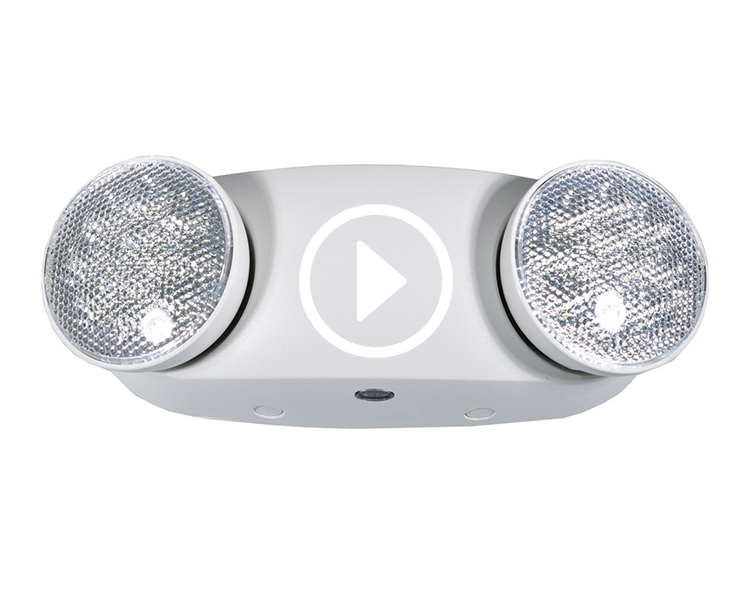 JLEU5-UL Twin-Head LED Emergency LightUL-listed dual-head emergency fixture with adjustable 360° LEDs, 90-minute battery backup, and 120/277V operation for egress-path illumination.View Product →
Exit Signs and Means-of-Egress Marking Under Section 7.10
Emergency lighting and exit marking are related, but they are not the same requirement. NFPA 101 Section 7.10 covers the signs that identify the means of egress. The legend must be readable, the sign must be illuminated, and the installation must remain visible under emergency conditions.
For the familiar "EXIT" legend, NFPA 101 calls for letters not less than 6 in. high with a stroke of at least 3/4 in. Signs may be internally or externally illuminated, but the illumination must be reliable and maintained. Directional indicators, chevrons, and arrows need to be consistent with the actual path of travel; a beautifully lit sign pointing into a dead-end corridor is still a compliance problem.
Exit sign combos are common in corridors because they combine the sign and emergency lamp heads in one housing. That can simplify wiring and placement, but it also means the battery and transfer circuit serve both functions. Check that the combo is listed for the intended mounting and that the lamp heads can cover the required floor area.
 JLECB2GW Slim Green Exit Sign ComboCombination exit sign and two-head emergency lighting unit with green letters, dual voltage, and 90-minute battery for corridor egress installations.View Product →
The 90-Minute Rating Is Not the Same as 90-Minute Performance
A product label may say 90 minutes. The installed system still has to deliver usable illumination at the end of that period. Battery capacity falls with age and temperature. A remote head added in the field can increase load. A loose connector can add resistance. None of those issues show up in a catalog cut sheet.
Where systems commonly fall short
- Batteries that have aged through several annual tests but were never replaced on a planned cycle.
- Remote lamp heads installed beyond the manufacturer's rated load or wire length.
- Fixtures in unconditioned spaces where high or low temperatures reduce battery performance.
- Exit sign panels that are illuminated but no longer meet the required legend size or contrast.
- Transfer circuits that switch on, but leave some lamps dark because of a wiring or driver fault.
Good design leaves margin. If a fixture is rated for 90 minutes at a given load, do not specify it at exactly that load in a hot ceiling plenum or a cold parking structure. Use the manufacturer's temperature and loading data, and verify that the selected battery pack is appropriate for the actual connected load.
Specifying Equipment That Supports Compliance
The most reliable procurement approach is to specify by function and evidence, not by appearance. Ask for the listing file, the model number, the input voltage, the output load, the battery type, and the rated duration. Confirm that the certificate covers the exact model and factory. A certificate for a similar housing or a discontinued series is not enough.
For retrofit work, an LED emergency battery pack or inverter can keep an existing fixture in service while adding emergency operation. The device must be compatible with the fixture's driver, voltage, and lamp load. In new construction, a listed emergency luminaire with a self-contained battery may be simpler to commission and test.
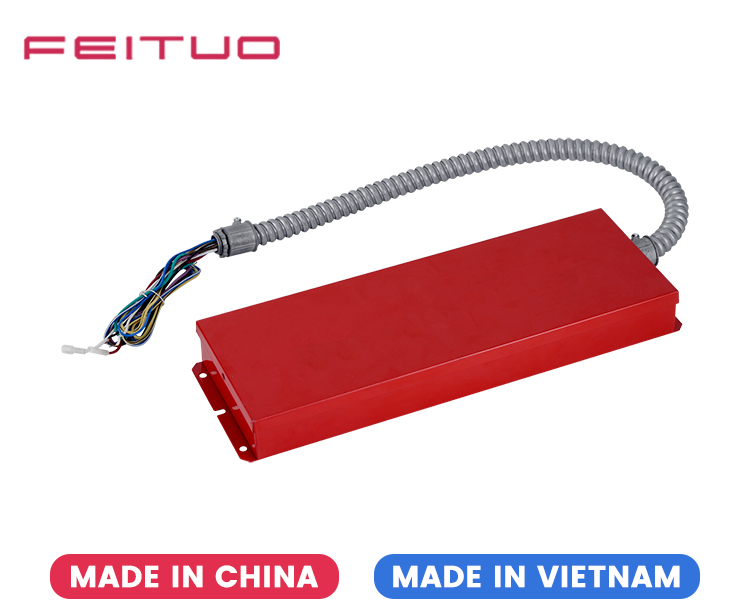 UL Listed LED Emergency Battery PackUL/CULus-listed retrofit battery pack for LED fixtures up to 20W, offering 90-minute emergency output and 120/277V or 120/347V options.View Product →
Documentation should follow the product. For example, a UL E464915 certificate of compliance is useful only when it matches the model being supplied. The same rule applies to CE and RoHS declarations: they support a market-access file, but they do not replace installation testing or AHJ acceptance.
Testing, Records, and AHJ Expectations
NFPA 101 Section 7.9.3 turns emergency lighting from a one-time installation into a maintenance obligation. The routine is straightforward, but it is easy to postpone until an inspection notice arrives.
- Perform a monthly test of not less than 30 seconds on every required emergency lighting system.
- Perform an annual test of not less than 1.5 hours.
- Keep written records of testing available for inspection by the authority having jurisdiction.
- Correct failed lamps, batteries, chargers, and transfer circuits before the next test interval.
Self-testing and self-diagnosing equipment can reduce manual effort, but it does not remove responsibility. The owner or facility manager still needs a record that the test occurred and that any faults were corrected. In a large portfolio, a simple test log with fixture ID, date, duration, result, and corrective action is more useful than a folder of undated photos.
A Practical Procurement Checklist
Use the following checks before releasing a purchase order. They apply to new construction, tenant fit-outs, and retrofit projects where existing fixtures are being reused.
| Item | What to verify | Why it matters |
|---|---|---|
| Code edition and AHJ | Confirm the adopted NFPA 101 edition and any local amendments. | Local adoption can change submittal and testing expectations. |
| Listing | UL 924 or another accepted listing; certificate matches the exact model. | Listing supports acceptance but does not prove installed performance. |
| Duration and load | Rated for at least 90 minutes at the actual connected load, including remote heads. | Overloading shortens runtime and creates end-of-test failures. |
| Illumination layout | Layout supports 1 fc average and 0.1 fc minimum initially; 0.6 and 0.06 at the end. | Code compliance is measured at the floor along the egress path. |
| Exit sign legend | 6 in. letters, 3/4 in. stroke, correct direction, visible from the required distance. | A lit sign can still fail if the legend or direction is wrong. |
| Environment | Temperature, damp or wet location, and enclosure rating suit the space. | Battery and electronics performance depend on installed conditions. |
| Testing method | Manual or self-testing approach matches the maintenance plan and record keeping. | The AHJ needs evidence that monthly and annual tests occurred. |
| Spare parts | Batteries, lamps, and drivers are available for the expected service life. | Obsolete parts turn a minor failure into a full fixture replacement. |
NFPA 101 emergency lighting compliance is not a single product decision. It is a chain: a listed fixture, a correctly sized battery, a layout that meets floor-level illumination, a readable exit sign, and a test record that proves the system still works. The numbers are specific, and the inspection is practical.
Start with the 1.5-hour duration and the illumination thresholds. Then verify the listing, the load, the environment, and the maintenance routine. That approach gives owners, specifiers, and installers a defensible path from submittal to annual test.


 NINGBO FEITUO ELECTRIC APPLIANCE CO., LTD.
 0086-574-87387582
 Website: www.ifeituo.com
 info@ifeituo.com
 Mob/WeChat/WhatsApp: 0086-135-6655-7272