Home
 English
 عربى
 Español
 русский
 Français
 中文简体
A maintenance technician pulls a 4-foot T12 lamp from a fixture, slides in a T8 tube because the pins line up, and the light comes on. Two weeks later it flickers, the ends darken, and the ballast runs hot. The physical fit was real; the electrical match was not. The short answer is that a T8 ballast and a T12 ballast are not interchangeable. They may share a socket and a tube length, but they are designed around different lamp currents, starting methods, and heat profiles. Treat the ballast label as the authority, not the lampholder.
The quick answer: same socket, different electrical recipe
T8 and T12 describe tube diameter, not ballast quality. A T8 tube is about 1 inch (25.4 mm) across; a T12 is about 1.5 inches (38.1 mm). Both commonly use a G13 medium bi-pin base and come in 4-foot lengths, which is why one can physically enter the other's lampholder. The ballast is the part that sets the electrical recipe: open-circuit voltage, operating current, starting method, and how many lamps it can drive. A ballast listed for two 32 W T8 lamps is not the same as one listed for two 40 W T12 lamps, even if the fixture looks identical from the outside. Most T12 systems use magnetic ballasts; most T8 systems use electronic high-frequency ballasts. Exceptions exist, so read the label.
What the ballast label tells you
| Item | T8 system | T12 system | What it means |
|---|---|---|---|
| Tube diameter | 1 inch (25.4 mm) | 1.5 inches (38.1 mm) | T8 is slimmer, but both often use G13 sockets. |
| Common 4-ft lamp | 32 W | 40 W | The ballast must match lamp wattage and current. |
| Typical ballast | Electronic, high frequency | Magnetic, line frequency | Exceptions exist; never assume by tube size alone. |
| Starting method | Instant, rapid, or programmed start | Rapid or instant start | A mismatch can cause flicker, hard starting, or short life. |
| Ballast losses | Generally lower | Generally higher | Actual savings depend on fixture, hours, and electricity rate. |
| Lamp swap | Not a universal drop-in | Not a universal drop-in | Use only listed lamp and ballast combinations. |
| Emergency version | Must match T8 lamp and normal ballast | Must match T12 lamp and normal ballast | Emergency output is a separate compatibility rating. |
Why a T8 lamp may light on a T12 ballast, and why that proves little
Physical compatibility is not electrical compatibility. A T12 magnetic ballast may strike a T8 lamp and produce light, especially in warm conditions. That does not mean the lamp is operating at its rated current. Symptoms include flicker, short lamp life, darkened ends, hard starting, reduced output, audible hum, and a ballast that runs hotter than expected. The reverse is also risky: a T12 lamp on a T8 electronic ballast may fail to start, strike erratically, or overheat because the ballast is not rated for that lamp's current. Manufacturer instructions and electrical listings are based on the matched combination. A fixture that works outside that combination is an unreliable field test, not a safe design.
The cost of a mismatch
Ballast mismatch rarely shows up as an immediate failure. It shows up as repeat lamp purchases, maintenance labor, and complaints about flicker. A T12 magnetic system also carries higher ballast losses than a modern T8 electronic system, but the saving depends on the entire fixture, operating hours, and electricity rate. The chart below is illustrative, not a substitute for nameplate data.
Retrofit paths that actually work
Option 1: replace the ballast, not just the lamp. For a fluorescent T12-to-T8 upgrade, install an electronic T8 ballast rated for the correct lamp count, wattage, input voltage, and starting method. Confirm the lampholders are rated for the new lamp and are not cracked or heat-damaged. In an emergency fixture, the emergency ballast or inverter is a separate compatibility layer; it must be matched to the new lamp and normal ballast. A fluorescent emergency ballast with a durable steel casing can be a practical starting point where the fixture is staying fluorescent.
 JEB Series Fluorescent Emergency Ballast with Painted Steel CasingFor fixtures staying fluorescent, this JEB series emergency ballast supports specified fluorescent lamps for at least 90 minutes and has a painted steel casing.View Product →
For LED conversions, do not assume a T8 LED tube is a drop-in. Ballast-compatible tubes require a compatible ballast; ballast-bypass tubes require rewiring and often removal of the ballast. Both must be listed for the application, and emergency operation needs a compatible LED emergency driver or battery pack. A fluorescent emergency inverter is not a universal replacement for an LED emergency module.
 ELS Series T8 36W Fluorescent Emergency InverterDesigned for one T8 36W 4-pin fluorescent lamp, this ELS series inverter provides at least one hour of emergency operation in a steel housing.View Product →
Option 2: replace the whole system with a listed LED retrofit. This can be cleaner when the existing ballast is old, the wiring is brittle, or the fixture is due for replacement. The key is to match the LED tube, driver, and emergency module as a system. A UL-listed LED emergency battery pack is not an accessory you choose by wattage alone; check input voltage, output, load, and enclosure requirements.
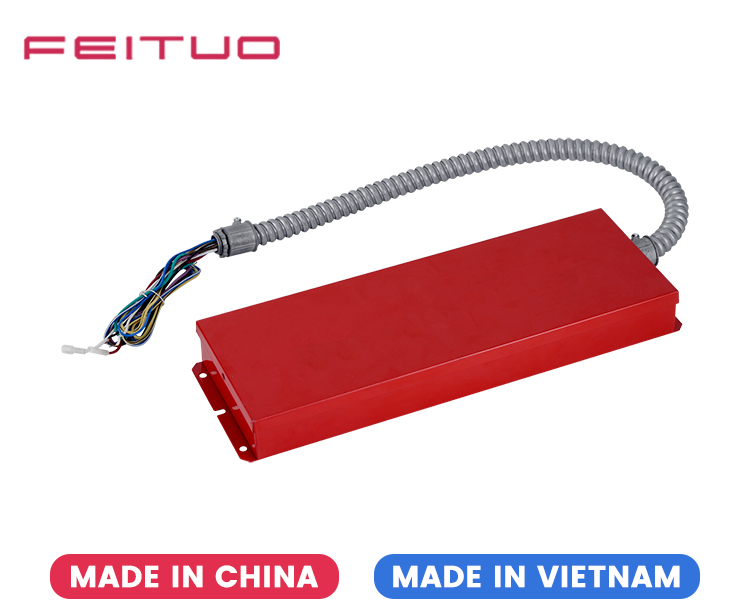 JLEB Series 20W LED Emergency Battery PackFor LED fixtures up to 20W with an internal driver, this UL-listed JLEB battery pack provides at least 90 minutes of emergency operation.View Product →
Emergency lighting adds a second compatibility layer
An emergency ballast is not a normal ballast with a battery bolted on. It charges a battery, monitors the normal supply, and switches to emergency output when power fails. Its output must be compatible with the lamp type, the normal ballast, and the required duration. A T8 emergency ballast designed for a T8 lamp and electronic ballast is not automatically suitable for a T12 magnetic system, and vice versa. If you change from T12 to T8, plan to review the emergency ballast, battery, and test switch as part of the same upgrade. The same logic applies to LED: a fluorescent emergency ballast should not be used to power an LED load unless the manufacturer lists that combination. The differences between emergency ballasts and regular ballasts matter even more when the lamp type changes.
A practical checklist before you buy
- Read the normal ballast label: lamp type, wattage, lamp count, input voltage, starting method, and maximum case temperature.
- Read the emergency ballast label separately: lamp compatibility, output, battery type, duration, and listed combinations.
- Measure the tube: T8 vs T12 diameter, length, and base. A G13 base does not prove electrical compatibility.
- Inspect lampholders and wiring for heat damage, brittle insulation, and loose contacts.
- Choose a path: T8 fluorescent ballast replacement, ballast-compatible LED tube, or ballast-bypass LED system.
- For emergency fixtures, verify code-required output duration and keep the listing documentation. A UL compliance certificate is useful evidence, but it must cover the actual product and combination.
Bottom line
T8 ballast vs T12 ballast is not a debate about which tube looks better. It is a compatibility question. T8 and T12 lamps may share a socket, but the ballast must be rated for the lamp type, wattage, count, and starting method. If you want to move a T12 fixture to T8, replace the ballast with a T8-rated electronic ballast and review the emergency components. If you move to LED, use a listed retrofit and a compatible emergency driver. The fixture that lights up is not necessarily the fixture that will last.


 NINGBO FEITUO ELECTRIC APPLIANCE CO., LTD.
 0086-574-87387582
 Website: www.ifeituo.com
 info@ifeituo.com
 Mob/WeChat/WhatsApp: 0086-135-6655-7272